
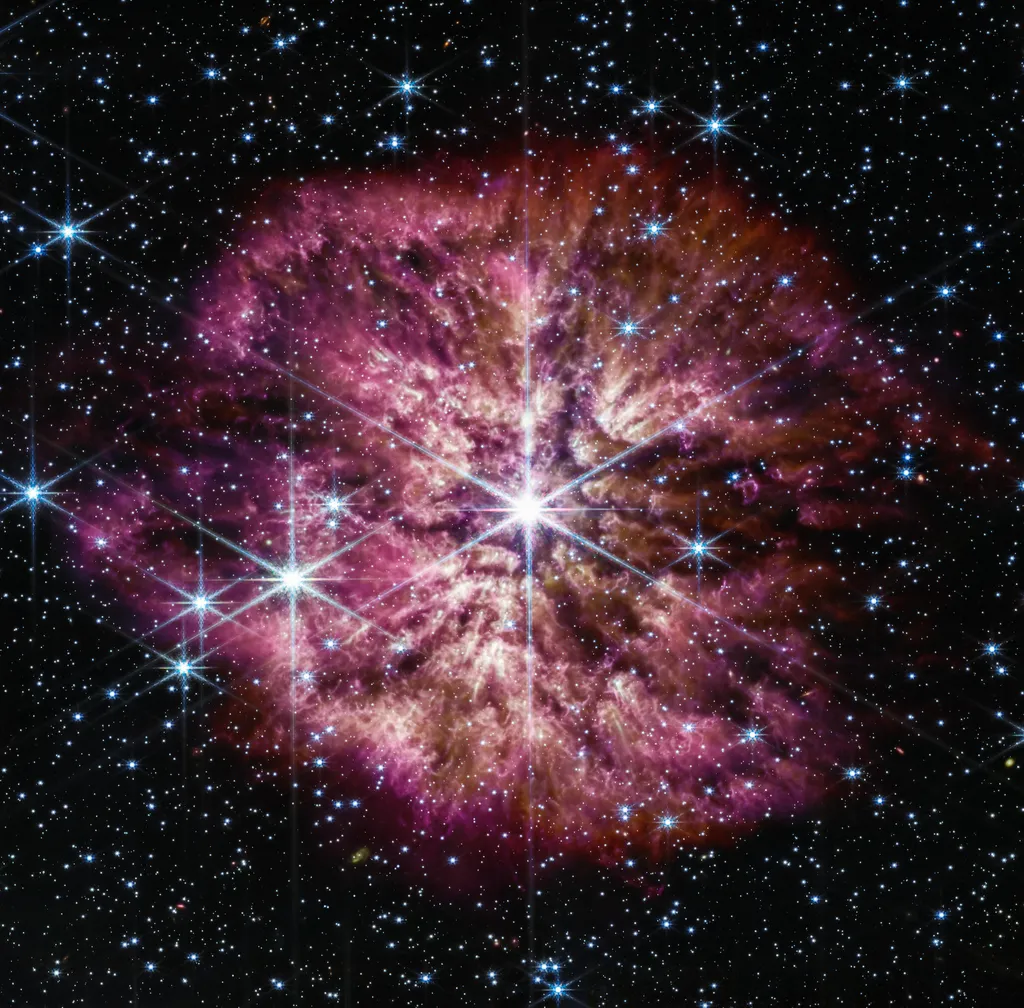
In the realm of astrophysics and energy research, a team of scientists led by Anindya Saha from the University of Sydney, along with collaborators from institutions like the University of Tasmania, the University of Liège, and the National Centre for Radio Astrophysics in India, has been investigating the potential of massive stars as significant contributors to galactic cosmic rays (GCRs). Their study, published in the journal Astronomy & Astrophysics, focuses on the Wolf-Rayet bubble NGC 2359, providing new insights into particle acceleration mechanisms that could have practical implications for understanding cosmic ray origins and potentially influencing energy technologies that rely on radiation shielding and detection.
Massive stars, particularly those in the Wolf-Rayet phase, emit powerful stellar winds that collide with the surrounding interstellar medium, creating strong shockwaves. These shocks are theorized to accelerate particles to relativistic speeds, producing cosmic rays. However, empirical evidence supporting this claim, especially for isolated stars, has been lacking. The researchers aimed to address this gap by studying NGC 2359, a nebula formed by the winds of a Wolf-Rayet star, using the upgraded Giant Metrewave Radio Telescope (GMRT) in India. They observed the bubble at low radio frequencies (250-950 MHz) and analyzed archival data to construct a broad spectral energy distribution (SED) for various regions within the bubble.
To better understand the interaction between the stellar wind and the ambient medium, the team developed a composite SED model that includes synchrotron and free-free emission, as well as two low-frequency turnover processes: the Razin-Tsytovich (RT) effect and free-free absorption (FFA). Using a Bayesian inference approach, they fitted the SEDs to constrain the electron number density and magnetic field strength within the bubble. Their analysis revealed spectral indices steeper than -0.5, indicative of synchrotron emission, and a turnover below approximately 1 GHz. The observed turnover was primarily attributed to the RT effect, with a minor contribution from internal FFA.
The detection of synchrotron radiation within NGC 2359 confirms that relativistic particle acceleration occurs in the vicinity of Wolf-Rayet stars. This finding is only the second of its kind, reinforcing the notion that such environments are potential sources of GCRs with energies up to at least GeV levels. While the practical applications of this research for the energy sector may not be immediate, understanding the origins and behavior of cosmic rays can inform the development of advanced radiation shielding materials and detection technologies, which are crucial for space exploration and the protection of energy infrastructure on Earth. Additionally, insights into particle acceleration mechanisms could contribute to the design of more efficient particle accelerators for various industrial and medical applications.
In summary, the study led by Anindya Saha and his collaborators provides compelling evidence that isolated massive stars, such as those in the Wolf-Rayet phase, can accelerate particles to relativistic speeds, generating cosmic rays. This research not only advances our understanding of astrophysical phenomena but also holds potential for practical applications in the energy sector, particularly in the development of radiation-related technologies.
This article is based on research available at arXiv.