
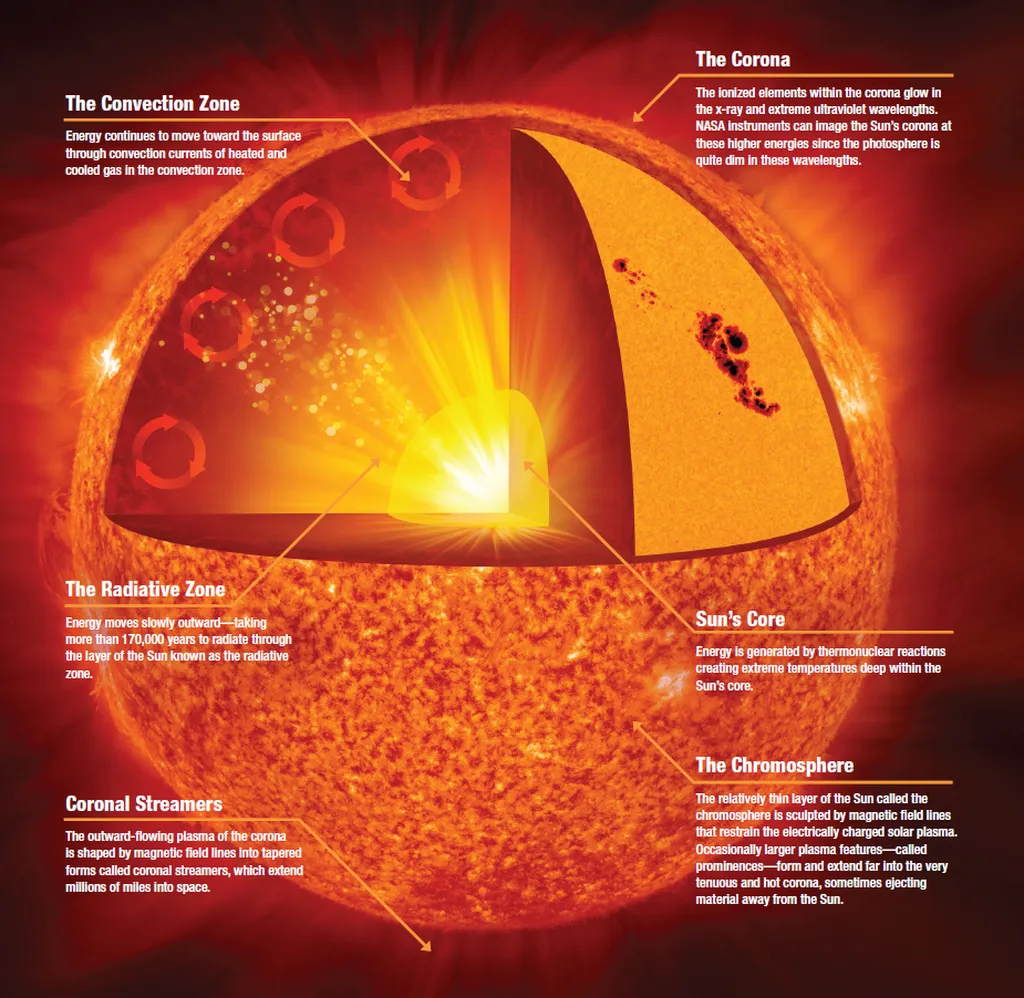
Researchers from the Max Planck Institute for Solar System Research and the Indian Institute of Astrophysics have been studying the Sun’s inertial modes, which are large-scale flow patterns within the Sun, to better understand its interior dynamics and magnetic activity. These scientists, led by B Lekshmi and including Zhi-Chao Liang, Laurent Gizon, Jordan Philidet, and Kiran Jain, have analyzed data from the Global Oscillation Network Group (GONG) and the Helioseismic and Magnetic Imager (HMI) over a period spanning from 2002 to 2024.
The team focused on two types of inertial modes: high-latitude modes with an azimuthal wavenumber of 1 and equatorial Rossby modes with wavenumbers ranging from 3 to 16. By examining these modes, the researchers aimed to understand how they evolve over the solar cycle, which is the roughly 11-year period during which the Sun’s activity, including sunspot number, wax and wane.
The researchers found that the frequencies of these inertial modes vary significantly over the solar cycle, with the magnitude of these variations increasing with higher wavenumbers. Interestingly, the power of these modes can change by more than 100% over time. For the high-latitude mode with an azimuthal wavenumber of 1, the power was found to be anti-correlated with the sunspot number, meaning that as the number of sunspots increased, the power of this mode decreased. However, the frequency of this mode did not show significant temporal variation.
For the equatorial Rossby modes, the frequencies were generally anti-correlated with the sunspot number, while the mode powers tended to correlate positively with the sunspot number. Notably, the mode with a wavenumber of 3 exhibited a strong anti-correlation with the sunspot number, setting it apart from the other equatorial Rossby modes.
The researchers concluded that the frequencies and power of the Sun’s inertial modes exhibit significant variability on solar-cycle timescales. However, this variability is not uniformly synchronized with the sunspot number, highlighting the complex interplay between solar interior dynamics and magnetic activity. The sensitivity of inertial modes to solar-cycle changes indicates their potential as a diagnostic tool for understanding the Sun’s interior dynamics and magnetism.
This research was published in the journal Astronomy & Astrophysics, providing valuable insights into the Sun’s behavior that could have implications for space weather prediction and our understanding of stellar interiors. While the direct practical applications for the energy sector may be limited, a deeper understanding of solar dynamics can indirectly benefit solar energy technologies by improving our ability to predict and mitigate the impacts of solar activity on Earth’s environment and infrastructure.
This article is based on research available at arXiv.