
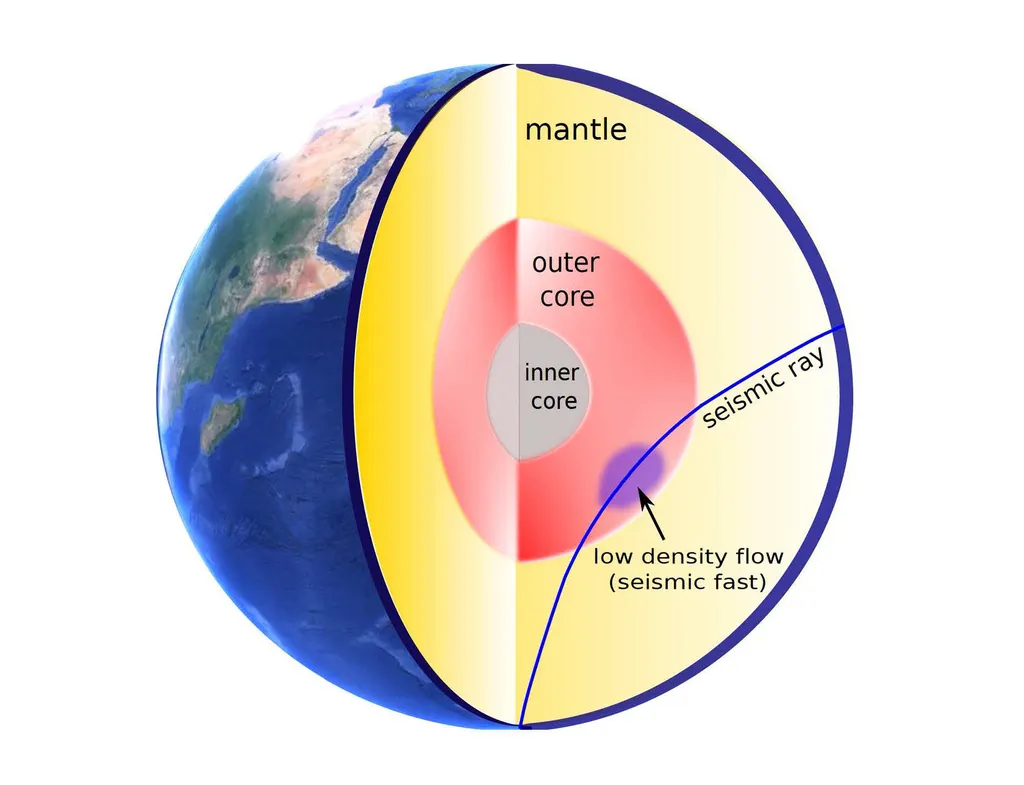
A team of researchers from the University of Minnesota, the University of Chicago, and the University of Science and Technology of China has shed new light on the behavior of hydrogen in Earth’s inner core. Their study, published in the journal Nature Geoscience, explores the thermodynamics of superionic hydrogen and its distribution within the planet’s deepest regions.
The researchers, led by Zepeng Wu and Renata M. Wentzcovitch, used advanced computational methods to calculate the Gibbs free energies of liquid and superionic phases of iron-hydrogen (Fe-H) compounds under the extreme pressure and temperature conditions found in Earth’s inner core. By constructing phase diagrams, they discovered that the partitioning of hydrogen between solid and liquid phases is primarily controlled by the temperature relative to the melting point of pure iron, rather than by pressure.
This finding reconciles previous discrepancies in theoretical studies and aligns well with experimental data at lower pressures. The team also applied thermochemical constraints to their free-energy results, revealing a radial gradient of hydrogen within the inner core. This means that the concentration of hydrogen varies with depth, increasing towards the center of the Earth.
The practical implications of this research for the energy sector are indirect but significant. Understanding the composition and behavior of Earth’s inner core can provide insights into the planet’s magnetic field, which is generated by the motion of molten iron in the outer core. This geomagnetic field is crucial for protecting Earth from solar radiation and space weather, which can impact satellite operations and power grids. Additionally, knowledge of the Earth’s deep interior can inform the search for new energy resources and help us better understand the planet’s long-term energy balance.
This article is based on research available at arXiv.