
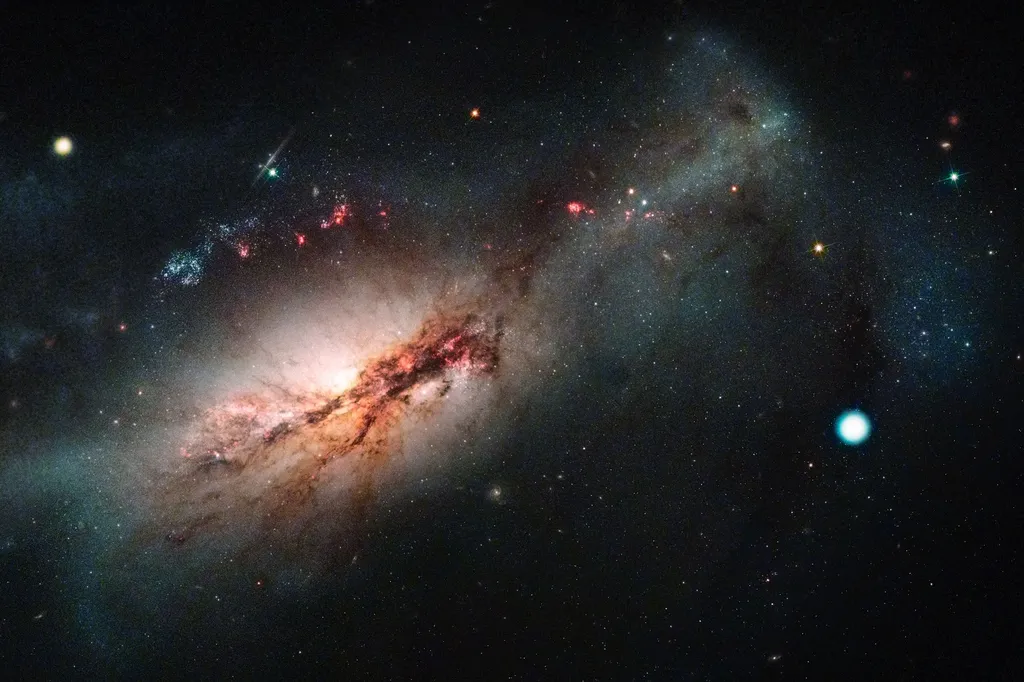
In a collaborative effort led by Samaporn Tinyanont and Kittipong Wangnok, a team of researchers from various institutions, including the University of California, Santa Cruz, and the University of Hawaii, has made an intriguing discovery about a peculiar type of supernova. Their findings, published in the Astrophysical Journal, shed light on the interactions between supernovae and their surrounding environments, which could have implications for our understanding of stellar evolution and the energy industry’s use of stellar phenomena as distance indicators.
The researchers studied a specific type of supernova, known as Type Ic, which is characterized by a lack of hydrogen and helium. They focused on a particular supernova, designated SN 2024aecx, which exhibited unusual behavior. Unlike typical Type Ic supernovae, SN 2024aecx showed a strong near-infrared (NIR) excess beginning around 32 days after its peak brightness. This excess was unexpected and had not been observed in other Type Ic supernovae.
The team proposed that this NIR excess was likely due to an infrared echo from pre-existing dust in the circumstellar medium (CSM) around the supernova. This dust, heated by the supernova’s light, re-emits the energy in the infrared spectrum. The researchers ruled out the possibility that the dust was newly formed in the supernova ejecta, as the timing of the NIR excess was too prompt for that process.
To explain the observed dust mass and temperature evolution, the researchers considered different potential CSM geometries. They found that a thick, face-on disk with an inner edge around 5×10^16 cm could best account for the observations. In this scenario, the supernova shock is expected to interact with this CSM around 440±200 days post-explosion.
The study of supernovae and their interactions with their surroundings can provide valuable insights into stellar evolution and the life cycles of stars. For the energy industry, understanding these processes can help improve the use of supernovae as standard candles for measuring cosmic distances, which is crucial for various energy-related applications, such as the development of advanced propulsion systems and the exploration of potential energy sources in space.
The research was published in the Astrophysical Journal, a peer-reviewed scientific journal that covers all aspects of astronomical research. The findings of this study contribute to our growing understanding of supernovae and their complex interactions with their environments, paving the way for further exploration and discovery in the field of astrophysics.
This article is based on research available at arXiv.