
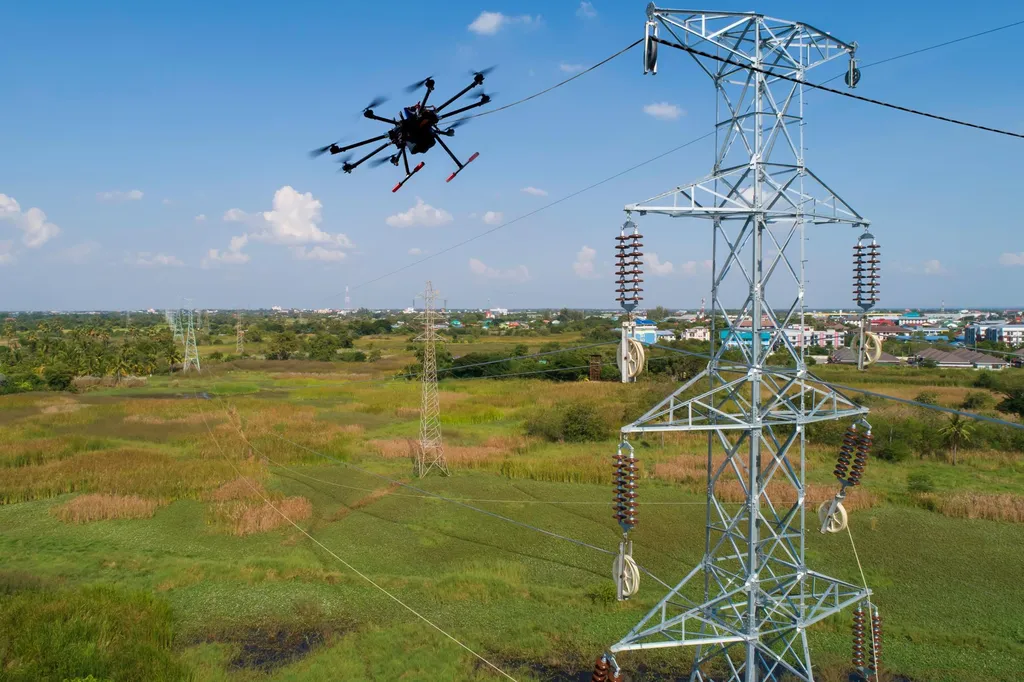
In the realm of energy infrastructure maintenance and inspection, unmanned aerial vehicles (UAVs) have emerged as valuable tools. However, the risk of collisions with power lines poses a significant challenge. Researchers Nicolaj Haarhøj Malle and Emad Ebeid from the Technical University of Denmark have developed a novel solution to enhance UAV safety around power lines. Their work was published in the IEEE Xplore Digital Library.
The researchers have created an omnidirectional, solid-state millimeter-wave (mmWave) radar perception system designed to provide spherical sensing coverage around small UAVs. This system integrates multiple compact mmWave radar modules to achieve a 360-degree field of view while maintaining a lightweight design suitable for UAVs. The system is specifically tailored to detect and avoid power lines, addressing a critical safety concern in both autonomous and manual UAV operations.
The team characterized the sensing behavior of their omnidirectional radar arrangement in environments with power lines and developed a robust detection-and-avoidance algorithm optimized for this behavior. Through field experiments on real power lines, they demonstrated the system’s effectiveness. The radar system reliably detected power lines at ranges up to 10 meters and successfully executed avoidance maneuvers at flight speeds exceeding 10 meters per second. Notably, the system could detect wires as thin as 1.2 millimeters in diameter, showcasing its high sensitivity and precision.
This research highlights the potential of mmWave radar technology to significantly enhance the safety of UAV operations in the vicinity of power lines. By providing an additional layer of collision avoidance, the system can reduce the risk of accidents, improve the efficiency of UAV-based inspections, and contribute to the overall reliability of energy infrastructure maintenance. The findings suggest that this technology could be integrated into existing UAV platforms to improve their operational safety and effectiveness in the energy sector.
The practical applications of this technology extend beyond power line inspections. The omnidirectional radar system could be employed in various UAV applications where collision avoidance is crucial, such as in wind turbine inspections, power plant monitoring, and other energy infrastructure assessments. By mitigating the risk of collisions, this technology can enhance the safety and efficiency of UAV operations, ultimately contributing to the advancement of the energy industry.
This article is based on research available at arXiv.