
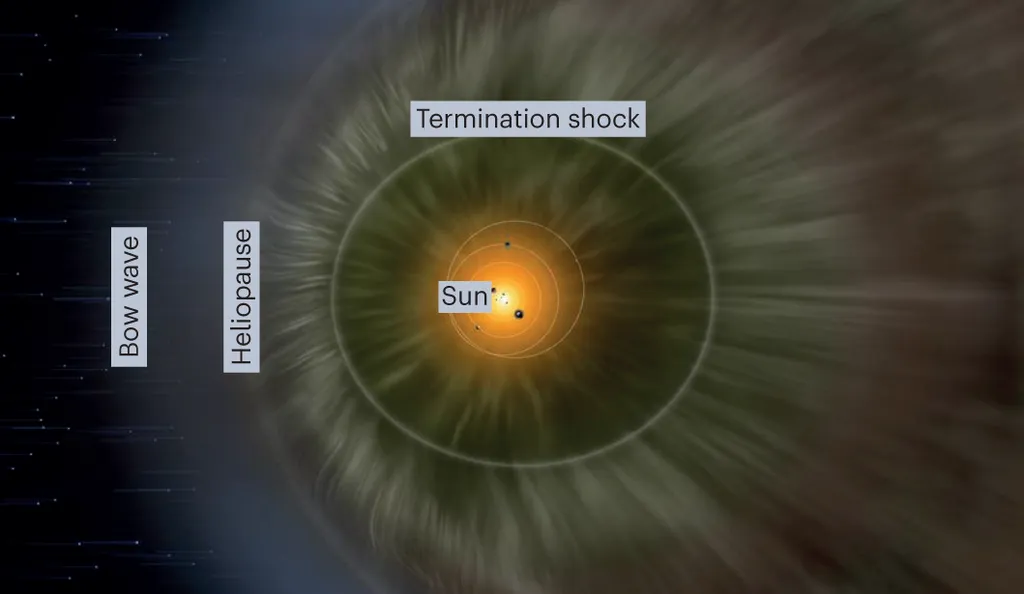
In the realm of astrophysics and energy research, a team of scientists from the Russian Academy of Sciences has been delving into the complex dynamics of plasma flows around clusters of massive stars. Researchers D. V. Badmaev, A. M. Bykov, and M. E. Kalyashova have recently published their findings in the journal Monthly Notices of the Royal Astronomical Society, shedding light on the intricate interplay of magnetic fields and stellar winds.
The research focuses on the evolutionary stage of star clusters dominated by Wolf-Rayet stars, which are massive, highly luminous stars nearing the end of their lifetimes. These stars emit powerful winds that collide and interact within the cluster, creating a collective wind that expands into the interstellar medium. The scientists used three-dimensional magnetohydrodynamic (3D MHD) simulations to study the expansion of this cluster wind bubble, taking into account the density and magnetic field of the surrounding medium.
The simulations revealed that the cluster wind can significantly reshape its environment over the lifetime of the Wolf-Rayet stars. In a cold neutral medium with a density of about 20 particles per cubic centimeter and a magnetic field of approximately 3.5 microgauss, the wind forms a thin shell around the bubble. This shell is characterized by a cellular structure in its density and magnetic field distributions, particularly in areas expanding perpendicular to the external magnetic field. The magnetic fields within the shell are amplified to strengths greater than 50 microgauss, a phenomenon associated with the development of instabilities.
The expansion of the bubble into a warm neutral interstellar medium also leads to the formation of a shell with an amplified magnetic field. This research provides valuable insights into the dynamics of star clusters and the role of magnetic fields in shaping the interstellar medium. Understanding these processes can help energy researchers better comprehend the environments in which stars and their associated phenomena, such as supernovae, occur. This knowledge can be crucial for modeling the energy output and lifecycle of massive stars, which are significant contributors to the energy balance of galaxies.
The practical applications for the energy sector include improved models for stellar feedback, which can influence the formation of new stars and the distribution of energy in galaxies. This, in turn, can enhance our understanding of the cosmic sources of energy and their impact on the interstellar medium. The research was published in the Monthly Notices of the Royal Astronomical Society, a prestigious journal in the field of astrophysics.
This article is based on research available at arXiv.