
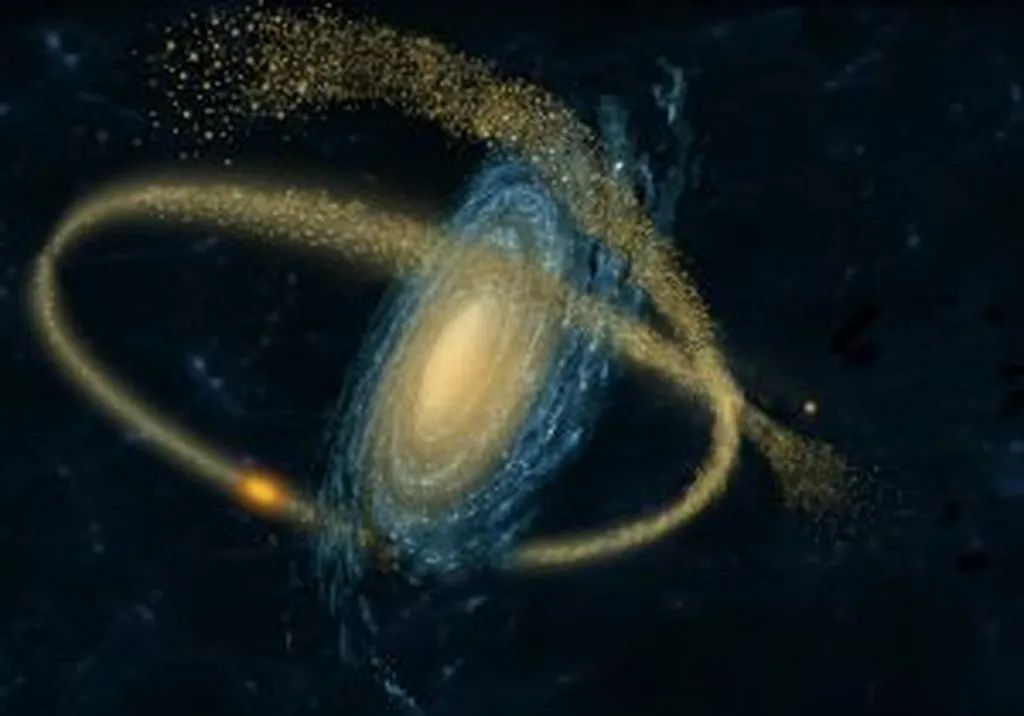
In a recent study, a team of astronomers from Tohoku University and the National Astronomical Observatory of Japan has delved into the characteristics of the globular cluster NGC 5466 and its tidal stream, using advanced imaging techniques. The researchers, led by Itsuki Ogami, have employed the Subaru/Hyper Suprime-Cam (HSC) with a metallicity-sensitive narrowband filter NB395 to gain insights into the nature of this celestial body.
The study, published in the Astrophysical Journal, presents a deep photometric analysis of NGC 5466, a globular cluster known for its low metallicity. The researchers developed an improved member-selection technique using a k-nearest neighbor algorithm applied to the color-color-magnitude diagram (CCMD). This method enables reliable identification of candidate stars within the cluster down to a magnitude of i2,0 < 23.5. The photometric metallicities derived from NB395 colors were found to agree with previous measurements, supporting the robustness of the calibration process. The spatial distribution of stars selected using the NB395 filter clearly delineates the tidal stream associated with NGC 5466. Beyond the tidal radius, the azimuthally averaged radial surface density profile of the stream follows a power law with a slope of α= -4.53. Additionally, a power-law component perpendicular to the stream was detected, suggesting multiple apogalactic passages. The researchers also identified a density gap at a projected distance of approximately 200 parsecs from the cluster center, which could be associated with a recent pericentric passage or interaction with the Galactic disk. The analysis of the main-sequence mass function revealed a strong negative radial gradient in the slope within the tidal radius, indicating that low-mass stars are more likely to be stripped away from the cluster. In contrast, the slope along the outer stream was found to be relatively flat, consistent with the preferential tidal stripping of low-mass stars. The findings of this study highlight the effectiveness of HSC/NB395 photometry for identifying metal-poor populations and deriving photometric metallicities. This technique holds significant value for future wide-field surveys, potentially enhancing our understanding of the structure and evolution of globular clusters and their tidal streams. For the energy sector, this research could indirectly contribute to the development of more accurate models for dark matter distribution, which is crucial for understanding the large-scale structure of the universe and its implications for energy distribution and cosmological simulations. This article is based on research available at arXiv.