
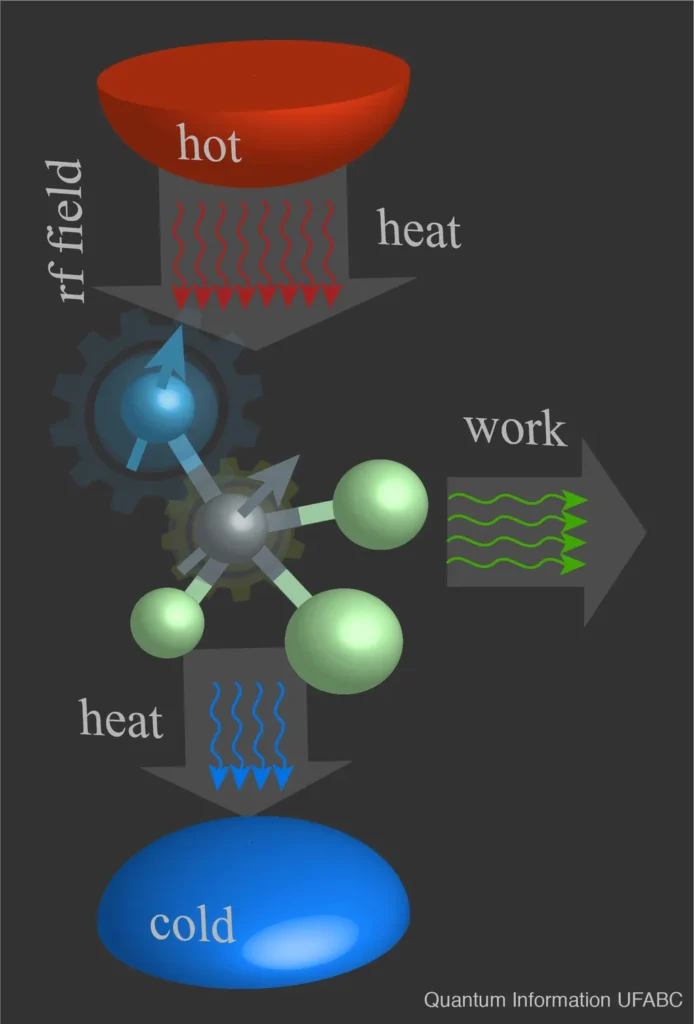
In the realm of energy research, a team of scientists from Griffith University and the University of Arizona has proposed a novel concept that could potentially revolutionize the way we think about heat engines. The researchers, André R. R. Carvalho, Liam J. McClelland, Erik W. Streed, and Joan Vaccaro, have introduced the idea of a quantum spin-heat engine (SHE) that operates differently from conventional heat engines. Their work was recently published in the journal Physical Review Letters.
Conventional heat engines operate between two thermal reservoirs, converting heat into work. However, the SHE proposed by Carvalho and his colleagues operates between energy and spin thermal reservoirs. This is a significant departure from the traditional model, as it introduces the concept of using spin, a quantum property of particles, as a resource for energy conversion.
The SHE operates in two main stages. In the first stage, heat from a thermal energy reservoir is converted into optical work via a two-photon Raman transition. This transition is resonant with close-to energy degenerate spin states, meaning the energy difference between the spin states is very small. In the second stage, the internal spin states are reset to their initial state using a spin reservoir. This reset process does not incur an energy cost but rather uses angular momentum from the spin bath that acts as the thermal spin reservoir.
The practical applications of this research for the energy sector are still in the early stages of exploration. However, the SHE represents an important first step toward demonstrating heat engines that operate beyond the conventional paradigm. This could pave the way for harnessing quantum coherence in arbitrary conserved quantities via similar machines, potentially leading to more efficient and innovative energy conversion technologies.
The research highlights the potential of quantum technologies in the energy sector. As our understanding of quantum mechanics continues to grow, so too does the potential for developing new and more efficient energy solutions. The SHE is a testament to the innovative thinking that is driving the energy sector forward, and it will be interesting to see how this concept evolves and is applied in the years to come.
This article is based on research available at arXiv.