
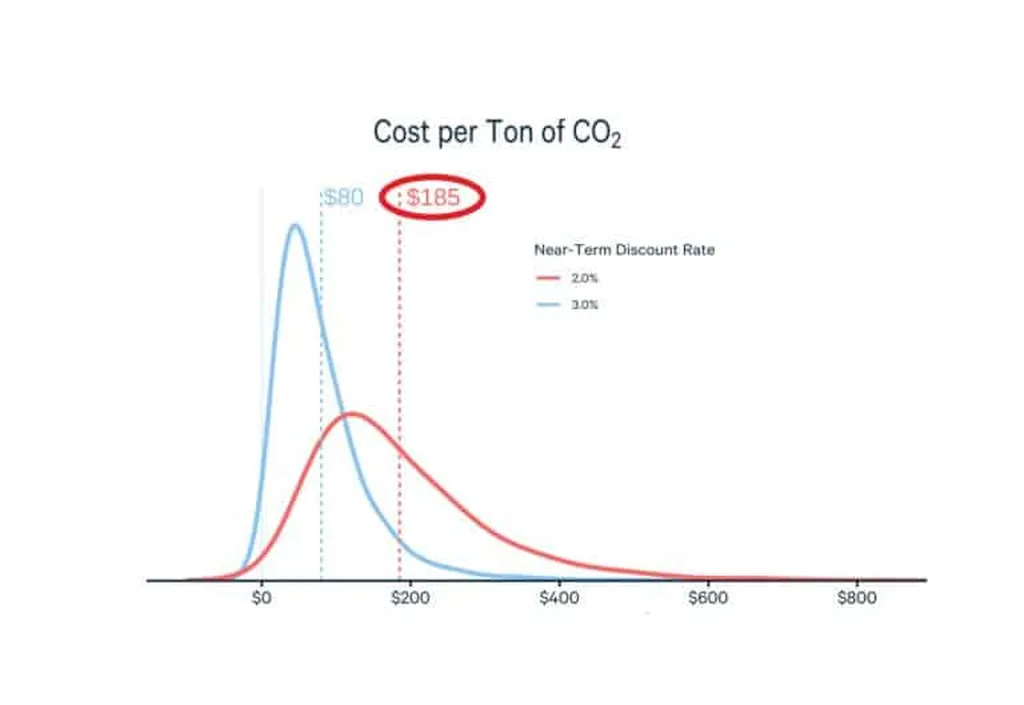
In a novel approach to estimating the social cost of greenhouse gases, a team of researchers led by Brian Hanley from the University of Colorado Boulder has developed a new model that combines physics and macroeconomics. The team, which includes prominent climate scientists Pieter Tans and Edward A. G. Schuur, along with Geoffrey Gardiner and Adam Smith, has introduced the Ocean-Heat-Content Physics and Time Macro Economic Model (OPTiMEM) to better understand the long-term impacts of greenhouse gas emissions. Their research was recently published in the journal Nature Communications.
The researchers propose a new way to estimate the social cost of carbon (SCC) by focusing on the relationship between ocean heat content and weather damages. They developed the “heat conjecture,” which assumes that weather damages are stochastically proportional to increases in ocean heat. This approach allows them to model the impacts of four key greenhouse gases: CO2, CH4, N2O, and halogenated hydrocarbons. Unlike previous methods, their model suggests that the social cost of these gases cannot be represented by single values but must be considered as a kind of economic phase space, accounting for various uncertainties and scenarios.
One of the practical applications of this research is the proposal for very long-term carbon bonds. These bonds would implement real discounting, addressing a long-standing debate in economics known as the Gordian knot of the descriptivist versus prescriptivist discount disagreement. By using these bonds, policymakers and economists can compare real-dollar spending and bond discount rates to the social cost of greenhouse gases, providing a more accurate picture of long-term economic impacts.
The OPTiMEM model also provides valuable tools for government officials, engineers, and actuaries. It offers 1:N year loss risk models (1:10, 1:100, 1:1000) that can help in planning and risk assessment. The researchers also highlight the importance of timely action, warning that delaying the transition to low-cost fossil fuel conversion could lead to significant challenges in achieving minimal CO2 emissions and maximal energy return on energy invested (EROEI). They argue that monetary value is fundamentally dependent on energy, emphasizing the need for sustainable energy practices.
In summary, this research provides a new, physics-based approach to estimating the social cost of greenhouse gases, offering practical tools and insights for the energy sector. By focusing on ocean heat content and proposing long-term carbon bonds, the study aims to bridge the gap between physical science and economic policy, ultimately supporting more informed decision-making in the energy industry. For further details, the full research article can be found in Nature Communications.
This article is based on research available at arXiv.