
In the realm of energy storage and electric aviation, two researchers from the Technical University of Munich, Eymen Ipek and Associate Professor Mario Hirz, have been exploring ways to improve battery management systems for electric vertical takeoff and landing (eVTOL) aircraft. Their work, published in the journal Nature Communications, focuses on enhancing the accuracy and efficiency of battery voltage predictions, which are crucial for the safe and effective operation of these aircraft.
The electrification of aviation brings with it unique challenges, particularly in managing the complex power dynamics of eVTOL aircraft. Traditional data-driven models, while highly accurate, often require intricate architectures and vast amounts of training data. On the other hand, equivalent circuit models (ECMs), which are based on physical principles, struggle to accurately predict battery behavior under high power demands, known as high C-rate non-linearities.
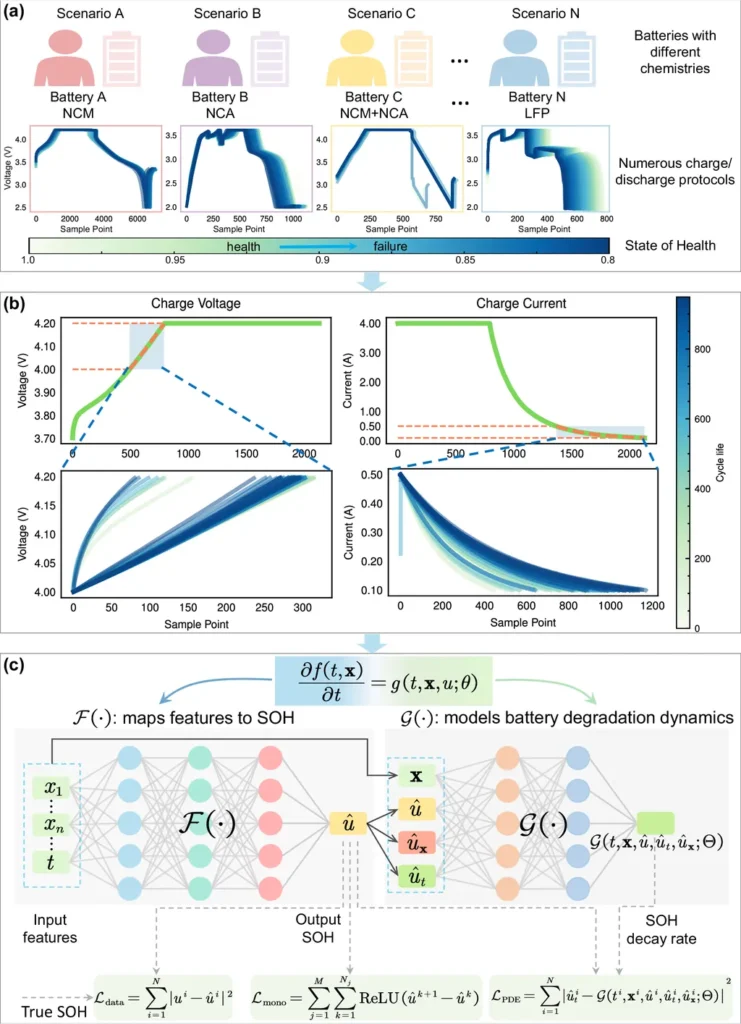
Ipek and Hirz investigated a hybrid approach that combines the best of both worlds: physics-informed data models. These models integrate physical insights into data-driven frameworks, potentially simplifying the neural network architectures without sacrificing accuracy. Using an open-source eVTOL battery dataset, the researchers compared pure data-driven models with physics-informed data models.
Their findings were promising. Physics-informed models achieved accuracy levels comparable to complex pure data-driven models but with a significant reduction in complexity. Specifically, these models used up to 75% fewer trainable parameters, which translates to a substantial decrease in computational overhead. This reduction is particularly beneficial for on-board deployment, where computational resources are often limited.
The practical applications of this research for the energy sector are substantial. Improved battery management systems can enhance the safety, efficiency, and reliability of electric aircraft. Moreover, the principles demonstrated in this study could be applied to other energy storage systems, such as those used in electric vehicles and grid storage solutions. By integrating physical insights with data-driven models, the energy industry can develop more accurate and efficient predictive tools, ultimately driving innovation and progress in the field.
The research was published in the journal Nature Communications, providing a valuable contribution to the ongoing efforts to advance energy storage technologies and their applications in various industries.
This article is based on research available at arXiv.