
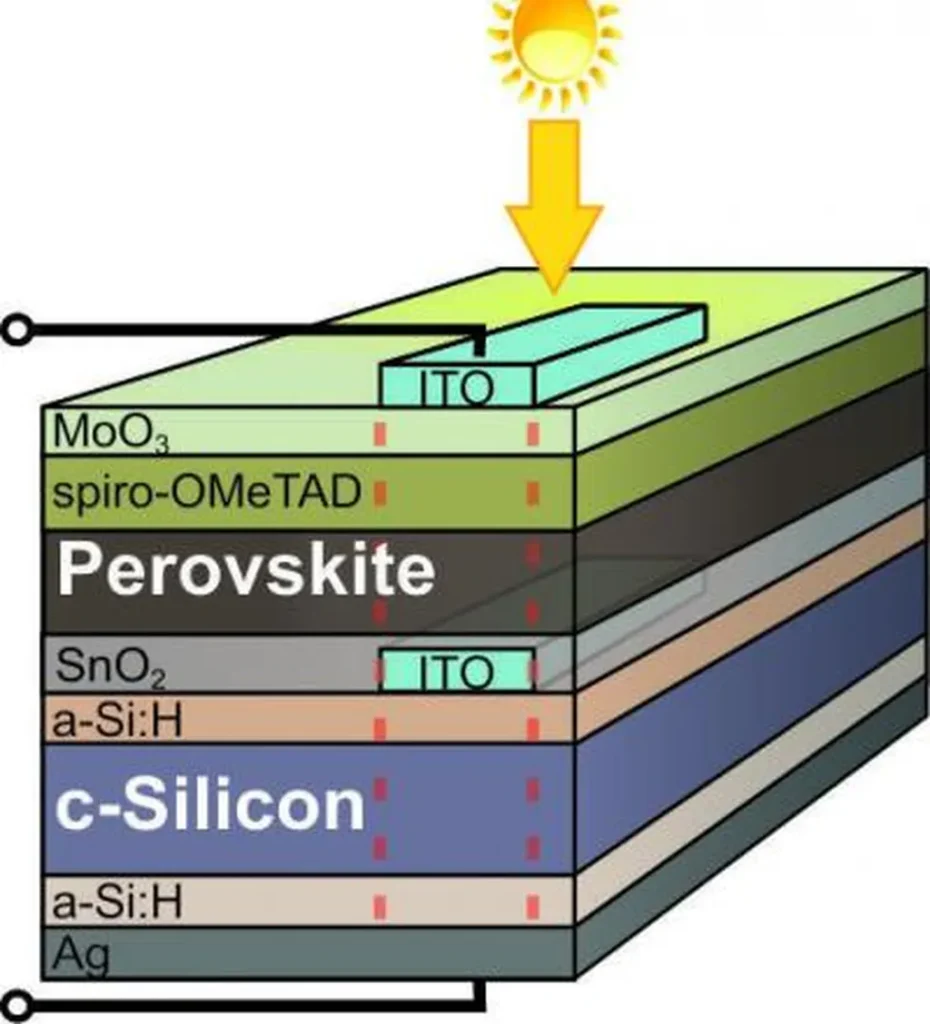
Scientists have pushed the boundaries of solar energy by achieving a record-breaking efficiency in perovskite-silicon tandem solar cells, marking a pivotal moment in the quest for high-performance, low-cost photovoltaics. This breakthrough, announced in late January 2026, demonstrates how layering perovskite materials atop traditional silicon cells can capture a broader spectrum of sunlight, surpassing the theoretical limits of silicon alone. The innovation positions tandem architectures as a cornerstone of the next wave of solar efficiency gains, offering a clear path to more powerful and affordable solar panels for both utility-scale and rooftop applications.
The technical leap hinges on the complementary absorption properties of perovskites and silicon. Perovskites excel at converting high-energy blue and green light into electricity, while silicon is more efficient with lower-energy red and infrared light. By stacking these materials, researchers have achieved lab efficiencies exceeding 33%—a figure once thought unattainable for commercial solar cells. “This is not just an incremental improvement; it’s a paradigm shift,” explains Dr. Henry Snaith, a leading perovskite researcher at the University of Oxford. “We’re now at the point where tandem cells can outperform the best single-junction devices on the market, and we’re doing it with processes that are scalable and cost-effective.”
The implications for global energy sustainability are profound. Higher efficiency means more electricity generated per square meter of solar panel, reducing land use and installation costs. This is particularly transformative for regions with limited space or high land costs, and for applications where weight and size matter, such as building-integrated photovoltaics. As production scales, perovskite-silicon tandems could accelerate the transition away from fossil fuels, making solar power the dominant energy source in more markets and sooner than previously anticipated. With pilot production lines already underway, industry watchers expect commercial modules to hit the market within the next two to three years, heralding a new era for renewable energy adoption worldwide.
Sources:
– [HotBot: Top Renewable & Alternative Energy Trends In 2026: Solar, Wind & Green Innovation]