
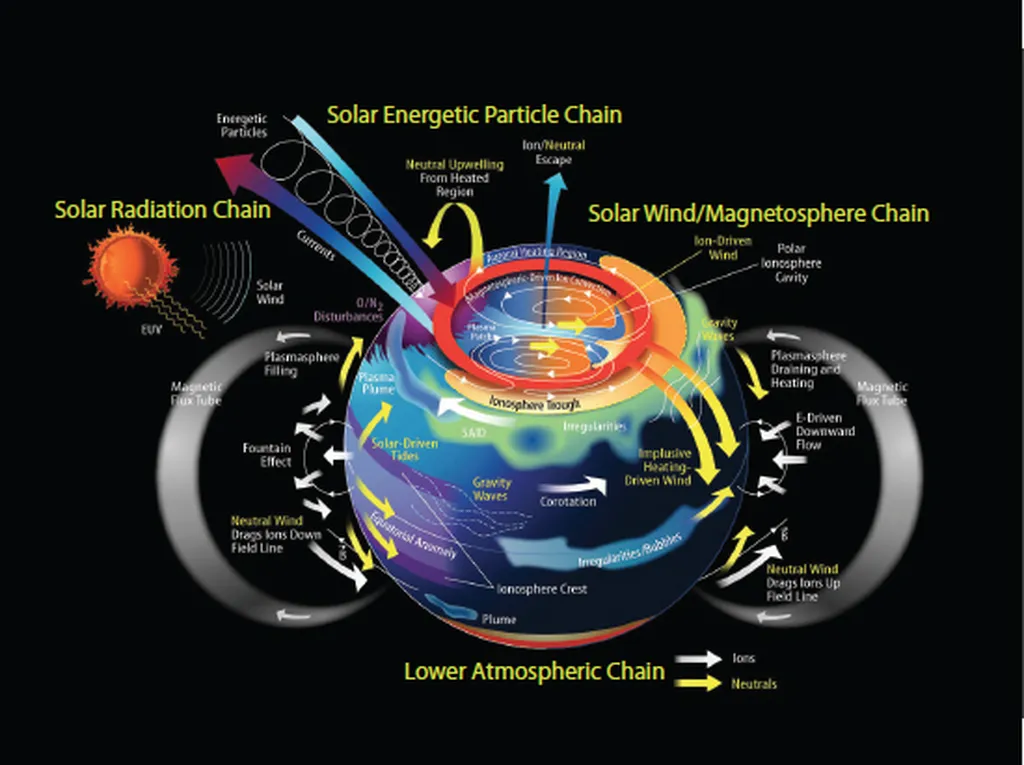
The International Space Station (ISS) has been a hub for numerous scientific experiments, and one recent study has focused on understanding the ionosphere, a critical region of Earth’s upper atmosphere that can impact satellite navigation and radio communication. The research team, led by Rachel Ulrich from the University of Colorado Boulder, includes Kelly R. Moran, Ky Potter, Lauren A. Castro, Gabriel R. Wilson, Brian Weaver, and Carlos Maldonado, who collectively have expertise in space physics and data analysis. Their work, published in the journal Geophysical Research Letters, involves the Electric Propulsion Electrostatic Analyzer Experiment (ÈPÈE), a compact device that measures ion energy in the ionosphere.
The ÈPÈE experiment was deployed on the ISS in March 2023 and collected data continuously through April 2024, a period that coincided with the peak of Solar Cycle 25. This timing allowed the researchers to capture unique observations of solar activity extremes in the mid- to low-latitude regions of the topside ionosphere. The ionosphere is a region of the Earth’s upper atmosphere that is ionized by solar radiation and plays a crucial role in radio communication and satellite navigation. Understanding its behavior is essential for the energy sector, particularly for satellite-based systems that rely on accurate ionospheric data for operations.
The researchers developed a statistical processing pipeline to analyze the data from ÈPÈE. This pipeline estimates the instrument’s noise floor, accounts for irregular temporal sampling, and extracts ionospheric signals. One of the key innovations of this method is that it does not discard noisy data but instead learns a baseline noise model. By using a scaled Vecchia Gaussian process approximation, the researchers were able to fit the measurement surface and recover values that would typically be rejected by thresholding. This approach increases data coverage and enables noise-assisted monitoring of ionospheric variability.
The practical applications of this research for the energy sector are significant. Accurate ionospheric data is crucial for satellite navigation systems, which are used in various energy applications, including oil and gas exploration, renewable energy projects, and grid management. Improved understanding of ionospheric variability can enhance the reliability and accuracy of these systems, leading to more efficient and effective energy operations. Additionally, better monitoring of space weather impacts can help mitigate potential disruptions to satellite-based communication and navigation systems, ensuring continuous and reliable energy sector operations.
In summary, the research conducted by Ulrich and her team provides valuable insights into the ionosphere’s behavior during periods of high solar activity. Their statistical processing pipeline offers a novel approach to analyzing ionospheric data, increasing data coverage and enabling more accurate monitoring. For the energy sector, this research underscores the importance of understanding and mitigating space weather impacts on satellite-based systems, ensuring the reliability and efficiency of energy operations.
Source: Geophysical Research Letters
This article is based on research available at arXiv.