
In the realm of energy and physics research, a team of scientists from the University of Mississippi, the University of California, and the University of Maryland have been delving into the mysteries of dark matter and its potential interactions with nuclear energy. Their recent study, published in the journal Physical Review Letters, explores the sensitivity of the Short-Baseline Near Detector (SBND) experiment to light dark matter using MeV-scale electromagnetic activity.
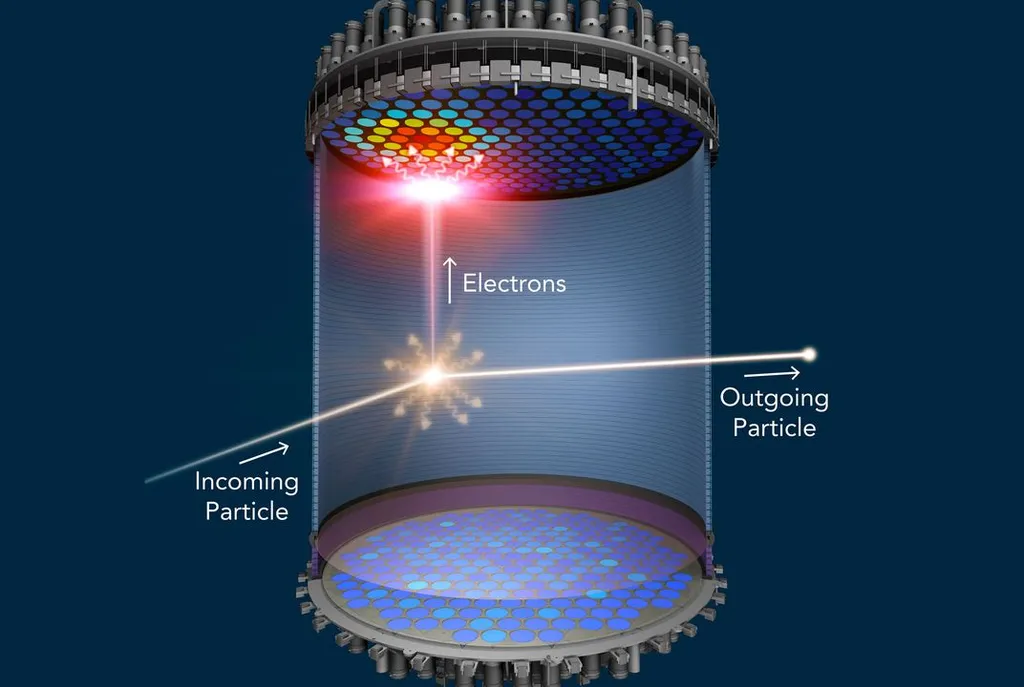
The researchers, including Bhaskar Dutta, Debopam Goswami, Baishan Hu, Wei-Chih Huang, and Vishvas Pandey, have focused on the inelastic scattering of dark matter with argon nuclei. This process can excite nuclear states that subsequently de-excite via the emission of MeV-scale photons, producing localized low-energy “blip” signatures in a liquid argon time projection chamber. The team performed state-of-the-art ab initio nuclear calculations, considering all relevant argon excited states with energies up to 18 MeV, to provide reliable predictions for these signals.
The study highlights the potential of the SBND experiment to probe previously unexplored regions of parameter space for light dark matter. By accounting for relevant backgrounds, the researchers have shown that SBND can detect these unique signals, which could open new avenues for understanding the nature of dark matter and its interactions with ordinary matter.
For the energy sector, this research could have significant implications. Understanding dark matter and its interactions could lead to advancements in nuclear energy technologies, particularly in the development of more efficient and safer nuclear reactors. The ability to detect and study these interactions could also pave the way for new energy production methods that harness the power of dark matter.
In summary, the team’s work represents a significant step forward in the search for dark matter and its potential applications in the energy sector. By leveraging the capabilities of the SBND experiment and advanced nuclear calculations, they have opened a new window into the mysteries of dark matter and its interactions with nuclear energy. This research, published in Physical Review Letters, underscores the importance of continued investment in fundamental physics research and its potential to drive innovation in the energy industry.
This article is based on research available at arXiv.