
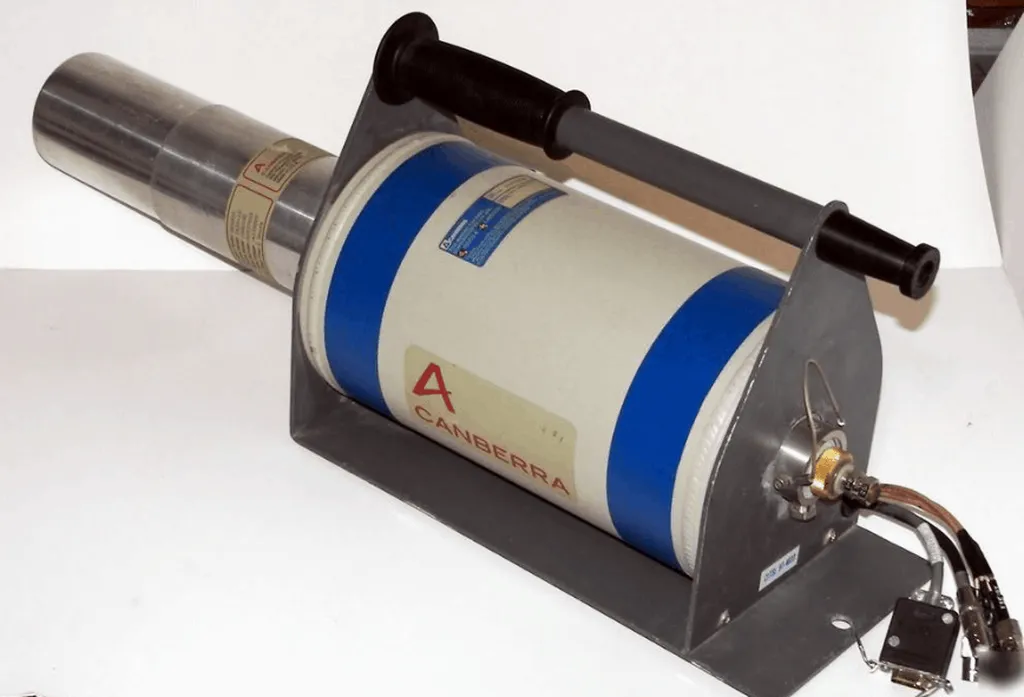
Researchers from the University of South Dakota, led by S. A. Panamaldeniya, have developed and tested new high-purity germanium (HPGe) detectors that could have significant implications for the energy sector, particularly in areas requiring precise radiation detection and measurement.
The team fabricated two p-type inverted coaxial point contact (ICPC) HPGe detectors, named SAP16 and SAP17, using crystals with very low impurity concentrations. These detectors employ thin amorphous-germanium (a-Ge) dual-blocking contacts, a first for ICPC detectors. These contacts are designed to block both types of charge carriers (electrons and holes) while minimizing the thickness of the dead layer, which is the part of the detector that does not contribute to the signal.
Electrical tests conducted at 76 Kelvin showed that both detectors operated stably with very low leakage currents and minimal capacitance. SAP17, for instance, achieved a leakage current of approximately 4.62 picoamperes at a bias of 500 volts and operated stably at 400 volts with a capacitance of about 0.503 picofarads. SAP16, on the other hand, demonstrated superior spectroscopic performance, achieving energy resolutions of 2.42% at 59.5 keV and 0.36% at 662 keV.
Gamma-ray spectroscopy tests using americium-241 and cesium-137 sources revealed that slight geometric differences between the detectors led to noticeable changes in depletion behavior and charge-collection uniformity. These findings were consistent with electrostatic modeling. Additionally, angular-response measurements showed that the detectors had pronounced directional sensitivity at 59.5 keV, while the response at 662 keV was essentially isotropic over the measured range.
The research, published in the journal Nuclear Instruments and Methods in Physics Research Section A: Accelerators, Spectrometers, Detectors and Associated Equipment, validates the use of thin a-Ge dual-blocking contacts for ICPC HPGe detectors. The findings also highlight the trade-offs among leakage current, depletion, and energy resolution driven by detector geometry. These insights could be particularly valuable for applications requiring low-background and low-threshold detection, such as environmental monitoring, nuclear safeguards, and medical imaging.
This article is based on research available at arXiv.