
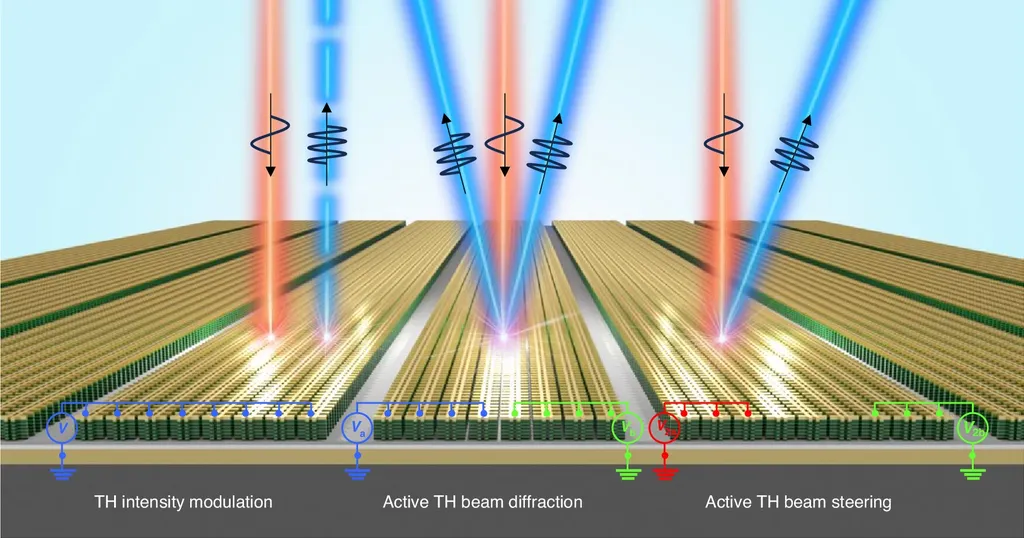
Researchers from Politecnico di Milano, led by Michele Celebrano, and their collaborators have made significant strides in the field of nonlinear optics, with potential applications for the energy sector. Their work focuses on a novel approach to enhance second-harmonic generation (SHG) using a large-area metasurface made from thin-film lithium niobate (TFLN) and titanium dioxide (TiO2).
The team demonstrated a scalable nanoimprint lithography technique to create a slanted TiO2 nanograting on etchless TFLN. This metasurface leverages quasi-bound state in the continuum (q-BIC) modes to achieve efficient and tunable narrowband SHG. The researchers reported a normalized SHG efficiency of 0.15% cm²/GW, which is among the highest reported for lithium niobate (LN) metasurfaces. Notably, the low pump peak intensity required for this process (3.64 kW/cm²) means that SHG can be achieved even with continuous-wave pumping, making it suitable for integrated and portable photonic applications.
The researchers also showcased the tunability of the SHG wavelength from 870 to 920 nm with stable output power and polarization control by using off-normal pump illumination. This versatility opens up new opportunities for various applications, including sensing, terahertz (THz) generation and detection, and ultrafast electro-optic modulation of nonlinear optical signals. The study was published in the journal Nature Communications.
For the energy sector, this research could lead to more efficient and compact devices for optical signal processing, sensing, and THz generation. These advancements could improve the performance of renewable energy systems, enhance the efficiency of energy transmission and distribution, and enable new methods for monitoring and controlling energy infrastructure. The low power requirements and scalability of the metasurface technology make it particularly attractive for practical, real-world applications.
This article is based on research available at arXiv.