
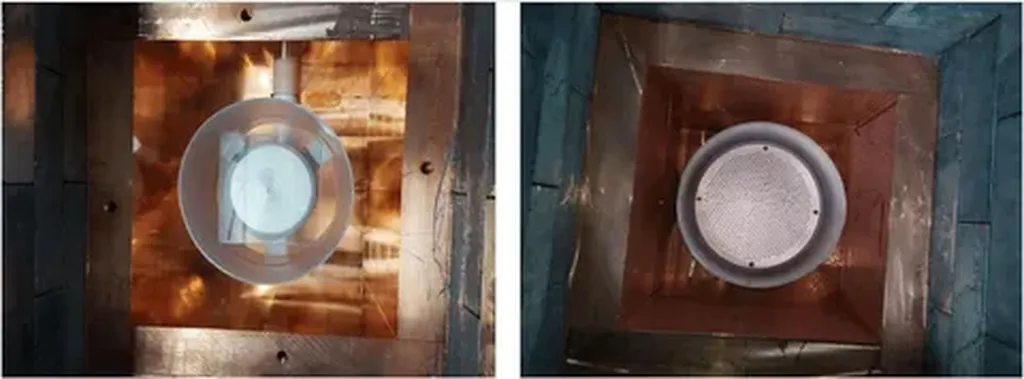
Researchers from various institutions, including the University of Coimbra, the University of Warsaw, and CERN, have collaborated on a novel approach to improve light collection and detection efficiency in noble gas time projection chambers (TPCs). These chambers are crucial for rare-event searches, such as dark matter detection and neutrinoless double-beta decay experiments.
The team has developed a new concept for electroluminescence (EL) structures, inspired by Gas Electron Multipliers (GEMs). In this approach, a wavelength-shifting material is deposited inside the holes of GEM-like structures. The electrodes of these structures are optically treated to enhance light collection. This innovation directly addresses scalability issues in future dual-phase TPCs, potentially outperforming conventional EL techniques.
The researchers have successfully manufactured a batch of these structures, dubbed FAT-GEMs, using laser-cutting techniques. This method allows for low-cost, high-volume, and reproducible production. The team has also simplified the optical treatment of the electrode surfaces, improving performance while eliminating charging-up effects from laminates.
Performance tests were conducted in pure argon at a gas density close to that expected in liquid argon (LAr) conditions. The results showed an energy resolution of 23.5±1% (FWHM) at 5.9 keV, indicating a significant improvement over previous batches. This enhanced performance suggests that the new structures could be beneficial for large-scale noble gas TPCs used in rare-event searches.
The research was published in the Journal of Instrumentation, a peer-reviewed, open-access journal covering instrumentation and measurement techniques in particle physics and related fields. The practical applications of this research could lead to more efficient and scalable detectors for the energy sector, particularly in monitoring and safety systems for nuclear reactors and waste management facilities. Additionally, the improved light collection and detection efficiency could enhance the performance of noble gas-based radiation detectors used in various industrial and environmental applications.
This article is based on research available at arXiv.