
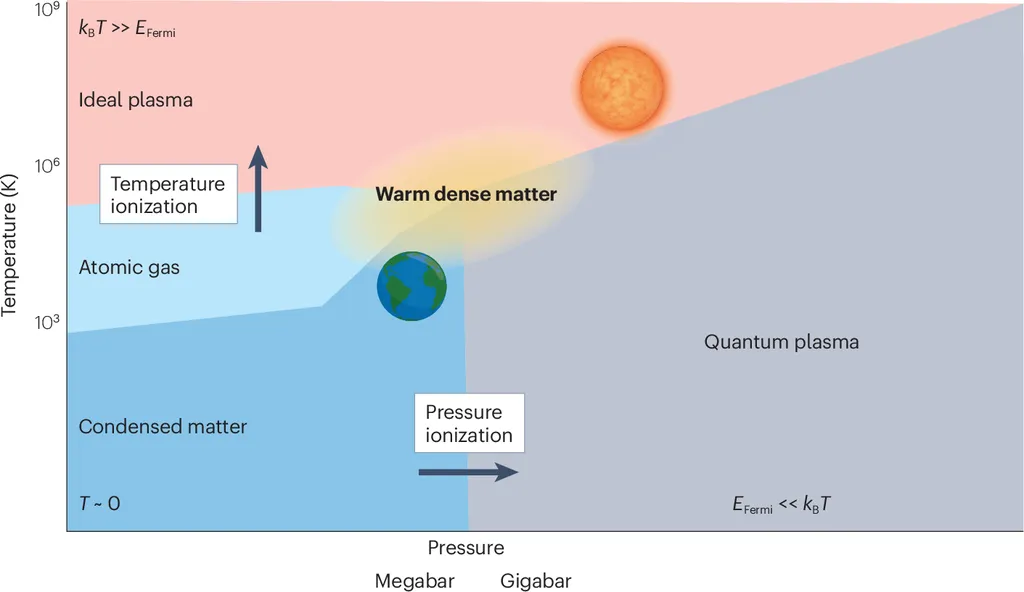
Researchers from the French National Centre for Scientific Research (CNRS) and the University of Bordeaux have developed a new modeling framework to better understand and design experiments involving warm dense matter, a state of matter that lies between condensed matter and plasma. This research, published in the journal Physics of Plasmas, has implications for various fields, including planetary science and inertial confinement fusion, a potential future energy source.
Warm dense matter is a complex state that is difficult to study due to its unique properties and the challenging conditions required to create it. In their work, the researchers focused on using pulsed-power facilities to heat thin metallic foils to achieve this state. Pulsed-power facilities generate extremely high electrical currents in very short periods, which can be used to heat materials to extreme temperatures and pressures.
The challenge in designing such experiments lies in simultaneously predicting the electrical response of the pulsed-power driver and the hydrodynamic evolution of the heated material. To tackle this, the researchers developed a modeling framework that couples an electrical description of the pulsed-power system with a one-dimensional hydrodynamic code. This coupling allows the electrical energy deposition and the load’s thermodynamic evolution to be consistently linked through the material’s electrical conductivity.
The researchers found that this approach, while retaining the simplicity of a one-dimensional geometry, could reproduce various measurements with good accuracy, such as expansion velocity, current, and voltage. This makes it a robust and efficient method for designing and optimizing future warm dense matter experiments using pulsed-power facilities.
For the energy sector, particularly in the field of inertial confinement fusion, this research could help in the design of experiments and facilities aimed at achieving net energy gain. By improving our understanding and modeling capabilities of warm dense matter, we can better predict and control the behavior of materials under extreme conditions, which is crucial for advancing fusion energy technologies.
The research was published in the journal Physics of Plasmas, a publication of the American Institute of Physics. The researchers involved in this study are Luc Revello, Laurent Videau, Frédéric Zucchini, Mathurin Lagrée, Christophe Blancard, and Benjamin Jodar.
This article is based on research available at arXiv.