
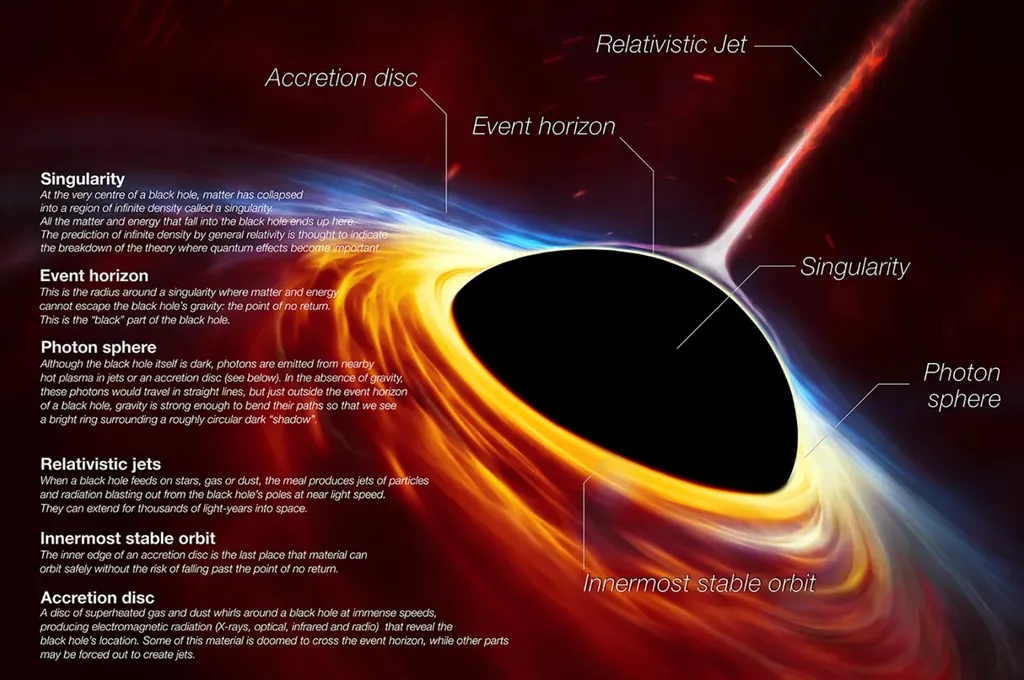
In the realm of theoretical physics, researchers are continually seeking to understand the enigmatic nature of black holes and the conditions that govern their behavior. Among these researchers is Milko Estrada, whose work delves into the intricate details of black hole physics. Estrada is affiliated with the Universidad Central “Marta Abreu” de Las Villas in Cuba, where he and his colleagues are exploring new models and solutions to longstanding problems in black hole theory.
Estrada’s recent research focuses on a novel approach to addressing the singularities that typically plague black hole models. Traditional black hole solutions often involve a de Sitter core, which can be unstable, and an internal horizon that disrupts predictability. To circumvent these issues, Estrada and his team have turned their attention to integrable singularities (IS), which avoid these problems and exhibit finite tidal forces, allowing for nondestructive radial infall.
The researchers present a new black hole solution sourced by a string fluid (FS) that exhibits an IS. This solution is motivated by the divergence of the conserved energy in the cloud of strings (CS) model. By introducing an energy density profile based on the screening of the CS energy density within an FS framework, the team achieves a finite conserved energy. This advancement could have significant implications for understanding the energy dynamics within black holes and potentially other astrophysical phenomena.
Additionally, the study establishes the conditions that an interior region with an IS must satisfy to represent a generic exterior black hole solution, with the Schwarzschild solution being just one particular case. The researchers derive the junction conditions (JC) between the interior and exterior regions, demonstrating that these conditions lead to temperature continuity at the interface. Discontinuities in tangential pressure, however, lead to phase transitions, providing insights into the thermodynamic behavior of black holes.
The nature of the interior region is proposed to be described by CS and FS, while the exterior corresponds to the Reissner-Nordström solution. This distinction could help in better understanding the structure and behavior of black holes, particularly in regions where traditional models fail.
The research was published in the journal Physical Review D, a prestigious publication known for its rigorous peer-review process and high standards in theoretical physics. While the practical applications for the energy sector are not immediately apparent, the theoretical advancements made in this research could lay the groundwork for future innovations in energy technologies, particularly those involving extreme gravitational fields and high-energy physics.
In summary, Estrada’s work represents a significant step forward in the understanding of black hole physics, offering new insights into the nature of singularities, energy dynamics, and thermodynamic behavior. As the energy sector continues to explore new frontiers in technology and innovation, the theoretical advancements made by researchers like Estrada could play a crucial role in shaping the future of energy production and utilization.
This article is based on research available at arXiv.