
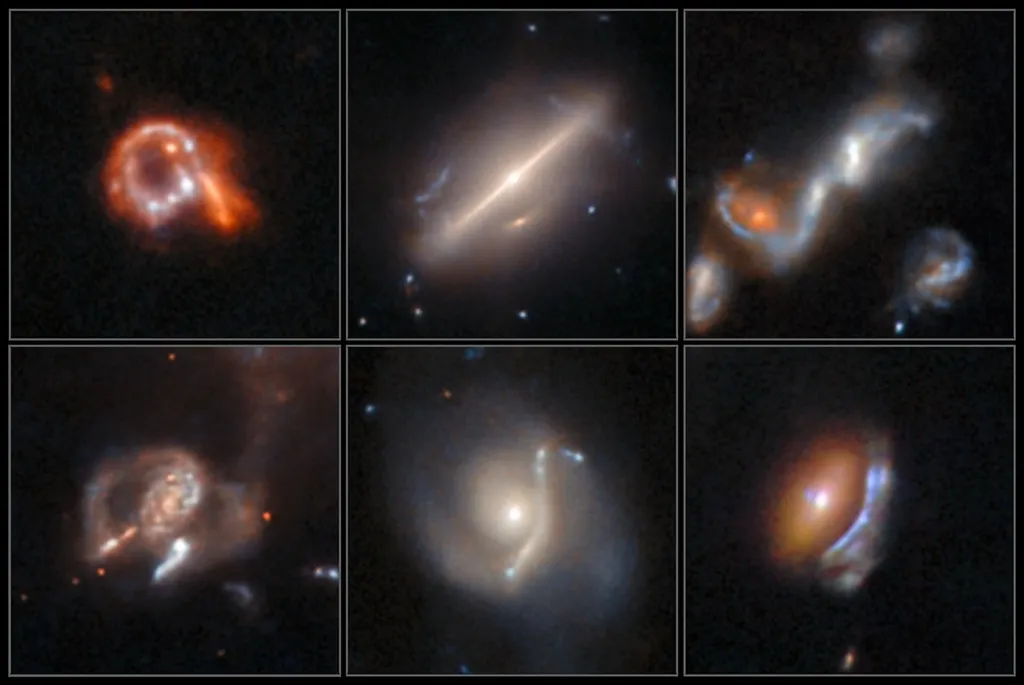
In the realm of astrophysics and energy research, a team of scientists from the Korea Astronomy and Space Science Institute has made strides in developing a method to identify galaxy mergers using advanced machine learning techniques. Their work, published in the Astrophysical Journal, could have implications for our understanding of galaxy evolution and, by extension, the energy dynamics of the universe.
The researchers, led by Yeonkyung Lee and including Hyunmi Song, Jihye Shin, Sungryong Hong, Jaehyun Lee, and Kyungwon Chun, focused on the potential of convolutional neural networks (CNNs) to distinguish between merging and non-merging galaxies. They utilized data from the Illustris TNG50 simulation, one of the highest-resolution cosmological hydrodynamic simulations available, to generate mock images resembling those that will be captured by the Rubin Observatory’s Large Synoptic Survey Telescope (LSST). This telescope is expected to reveal the low surface brightness universe with unprecedented precision, including faint tidal features that are typically harder to observe.
The team’s goal was to assess whether these faint tidal features, which are often fainter than 26 magnitudes per square arcsecond, could aid in classifying galaxy mergers. They trained their CNN model on a dataset of 151 Milky Way-like galaxies in field environments, comprising 81 non-mergers and 70 mergers. After applying data augmentation and hyperparameter tuning, the model achieved an accuracy of 65-67% in distinguishing between mergers and non-mergers.
To further optimize the model, the researchers conducted additional image processing. They found that when the model was trained on images containing only faint features, its accuracy improved to 67-70%. This represents a significant improvement of approximately 5% compared to training on images with bright features only. The results suggest that faint tidal features can indeed serve as effective indicators for distinguishing between mergers and non-mergers.
The practical applications of this research for the energy sector are indirect but noteworthy. Understanding galaxy mergers and their dynamics can provide insights into the large-scale structure and energy distribution of the universe. This knowledge can inform theoretical models and simulations used in cosmology and astrophysics, which in turn can contribute to our understanding of dark matter, dark energy, and the fundamental forces shaping the cosmos. While these findings may not have immediate implications for energy production or consumption on Earth, they contribute to the broader scientific understanding that underpins technological innovation and energy research.
This article is based on research available at arXiv.