
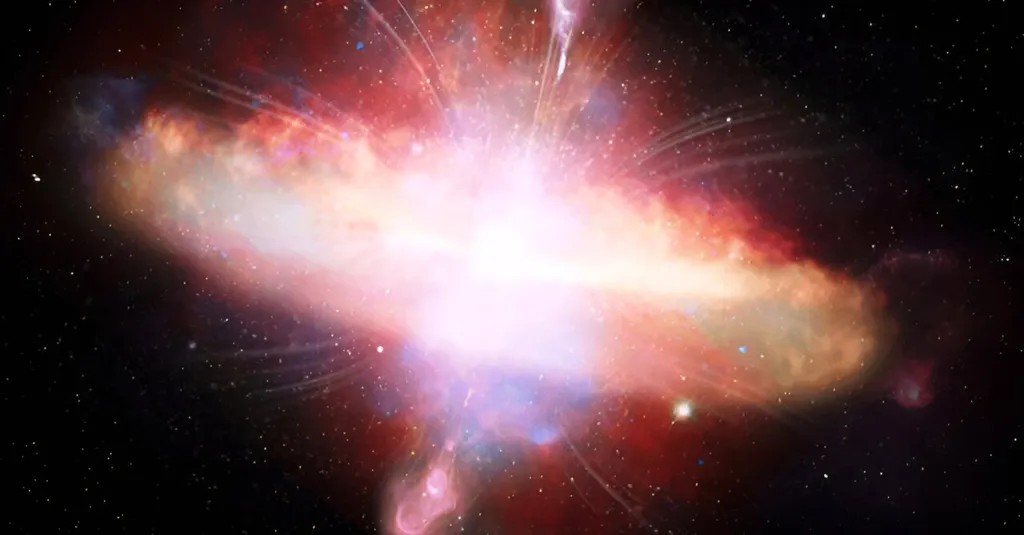
In a recent study, a team of researchers led by Marie-Lou Gendron-Marsolais from the University of Turku in Finland, along with colleagues from various institutions including the University of Padova in Italy and the Instituto de Astrofísica de Andalucía in Spain, investigated the origin of radio emissions from candidate super-Eddington accreting black holes. These black holes are of particular interest due to their extreme radiative output and potential role in galactic evolution.
The researchers focused on a sample of 18 super-Eddington candidates across a wide range of redshifts. These sources are expected to have high-velocity outflows and are thought to significantly influence galactic evolution through radiative and mechanical feedback. The team presented new observations from the Karl G. Jansky Very Large Array (VLA) at L, C, and X-bands, combined with data from the LOw-Frequency ARray (LOFAR) Two-metre Sky Survey (LoTSS) and the Very Large Array Sky Survey (VLASS). Additionally, they used optical and infrared data to estimate accretion and wind parameters, as well as star formation rates, to compare with those derived from radio emissions.
The study found that the radio emissions from these sources can originate from different mechanisms. Seven of the 18 targets showed radio emissions predominantly from star formation (SF), while six exhibited a combination of SF and active galactic nucleus (AGN)-related mechanisms. Only three sources indicated that the detected radio emission was solely from a core or jetted AGN. This supports the idea that lower power radio structures associated with star-forming activity are more prevalent than relativistic jets in the high Eddington ratio regime. However, the researchers also identified three sources where data suggested the presence of both super-Eddington accretion and relativistic ejections.
The findings of this study were published in the journal Astronomy & Astrophysics. The results provide valuable insights into the nature of radio emissions from super-Eddington accreting black holes and their role in galactic evolution. Understanding these mechanisms can help energy researchers develop better models for the interaction between black holes and their host galaxies, potentially influencing future energy-related technologies and applications in astrophysics.
This article is based on research available at arXiv.