
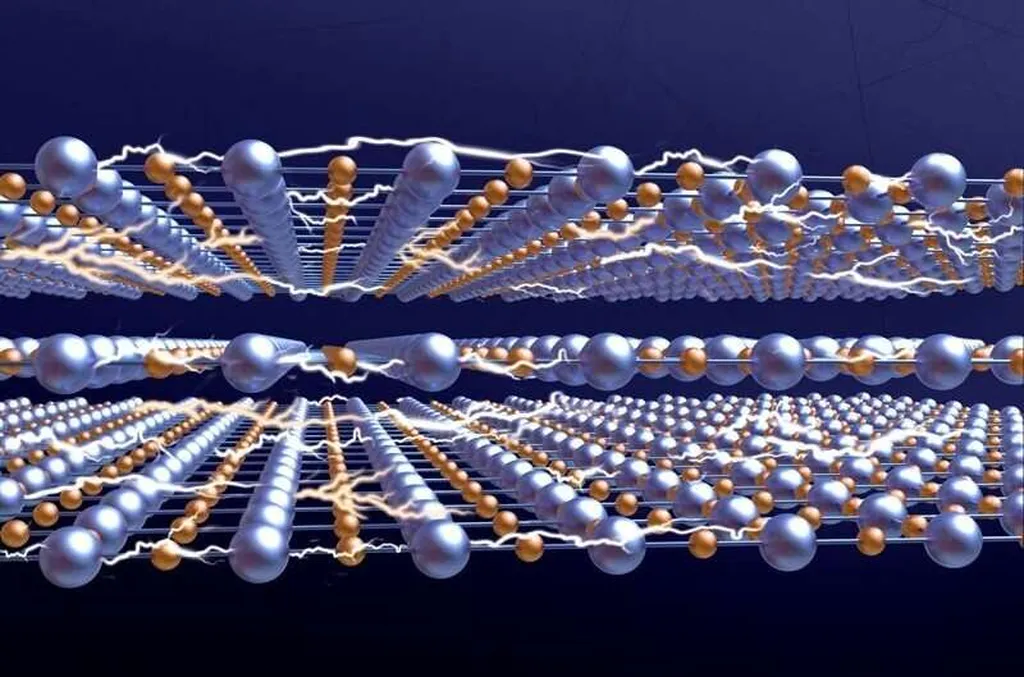
Researchers from the University of Illinois at Urbana-Champaign, led by Professor Peter Abbamonte, have recently published a study in the journal Nature Communications that sheds new light on the enigmatic “strange metal” state of certain high-temperature superconductors. The team, including Niels de Vries, Eric Hoglund, Dipanjan Chaudhuri, Sang hyun Bae, Jin Chen, Xuefei Guo, David Balut, Genda Gu, Pinshane Huang, and Jordan Hachtel, employed advanced electron energy-loss spectroscopy (EELS) techniques to investigate the charge response of the strange metal state in the compound Bi2Sr2CaCu2O8+x (Bi-2212).
The strange metal state is a perplexing phase of matter that exhibits unusual electronic properties, such as a linear temperature dependence of electrical resistivity, which is not well understood within the conventional framework of solid-state physics. To better comprehend this state, the researchers aimed to study the momentum- and frequency-dependent charge susceptibility, χ(q,ω), of Bi-2212, particularly at large momenta. EELS, performed in transmission geometry, provides a direct probe of this quantity.
The team achieved high energy resolution (ΔE ≈ 30 meV) and high momentum resolution (Δq ≈ 0.01 Å⁻¹) in their measurements, addressing issues of reproducibility by repeating the experiments ten times on five different Bi-2212 flakes. They also benchmarked their results against aluminum, a well-characterized Fermi liquid, and compared them with prior studies spanning four decades.
Their findings revealed that at momenta q < 0.15 Å⁻¹, a highly damped plasmon exists, with a linewidth comparable to its energy. At larger momenta, q > 0.15 Å⁻¹, this excitation does not disperse but instead evolves into an incoherent continuum. This observation contradicts some earlier works that reported a dispersing, RPA-like plasmon. The researchers also noted that their results align with recent resonant inelastic X-ray scattering (RIXS) measurements on Bi-based cuprates, supporting the view that Bi-2212 is an incoherent metal with strongly damped charge excitations.
The practical implications of this research for the energy sector are not immediate, as the study primarily focuses on fundamental physics. However, a better understanding of the strange metal state and its charge response could potentially contribute to the development of novel, high-temperature superconductors. These materials could revolutionize the energy industry by enabling highly efficient power transmission and generation, as well as advanced energy storage solutions. While the path from fundamental research to practical applications is often long and uncertain, studies like this one are crucial for driving progress in the field of energy-related materials science.
Source: Nature Communications, “Reexamining the strange metal charge response with transmission inelastic electron scattering” (2023)
This article is based on research available at arXiv.