
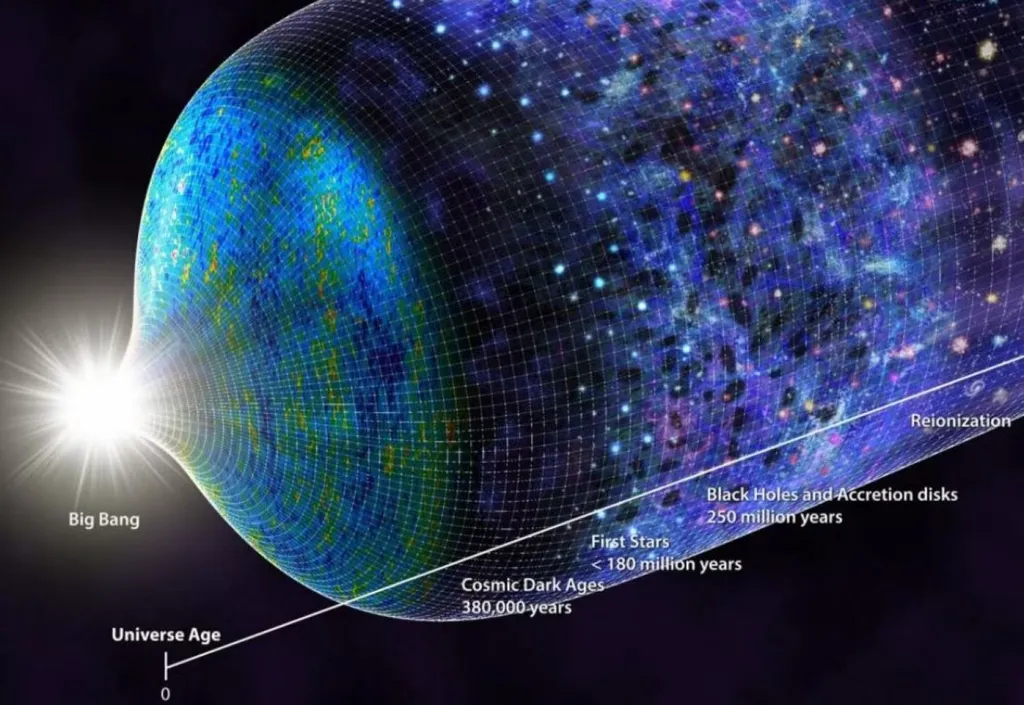
Researchers Shintaro Yoshiura, Fumiya Okamatsu, and Tomo Takahashi from the University of Tokyo have published a study that explores the detectability and model-selection power of the 21 cm signal from neutral hydrogen atoms, which is almost the only way to directly probe the Dark Ages of the universe. The Dark Ages 21 cm signal, observed at frequencies below 50 MHz, can serve as a powerful probe of cosmology, as the standard cosmological model predicts a well-defined 21 cm spectral shape. The research was published in the journal Physical Review D.
The study assesses the detectability and model-selection power of 21 cm observations assuming physically motivated foregrounds, optimistic error levels, and several observing strategies for the signals predicted in various cosmological models. The researchers used a Bayesian evidence-based comparison to evaluate the data.
The findings indicate that wide-band observations covering the frequency range of 1-50 MHz can identify the evidence of non-zero 21 cm signals from models considered in this paper, except for the one with a smooth spectrum that peaks at lower frequencies. Observations below 15 MHz are essential to avoid degeneracies with the foreground. Furthermore, even with observations measured at 5 MHz intervals over the frequency range 1-50 MHz, the 21 cm signal can be identified if the errors are sufficiently small. This suggests that the intrinsic 21 cm spectral shape can be captured without foreground degeneracy even with a limited number of frequency channels.
For the energy industry, this research highlights the potential of low-frequency radio observations to probe the early universe and improve our understanding of cosmology. While the direct practical applications for the energy sector may not be immediately apparent, the study underscores the importance of advancing our knowledge of the universe and the fundamental laws that govern it. This can indirectly support the development of new technologies and approaches in the energy sector, as well as inspire innovation and creativity in the scientific community.
This article is based on research available at arXiv.