
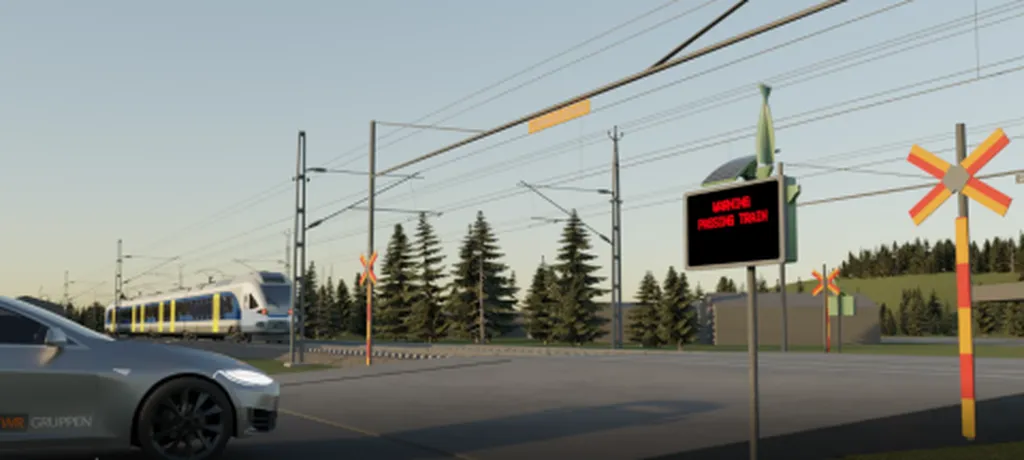
Researchers Chenyang Yan and Mats Bengtsson, affiliated with the Department of Electrical Engineering at Linköping University in Sweden, have conducted a comprehensive survey on obstacle detection technologies for railway level crossings, particularly focusing on their performance under adverse weather conditions. Their work, published in the journal IEEE Transactions on Intelligent Transportation Systems, aims to enhance safety in modern railway systems by improving the reliability and accuracy of obstacle detection methods.
Level crossing accidents continue to pose a significant safety challenge for railway operators, especially when adverse weather conditions degrade the performance of sensors. Yan and Bengtsson’s survey examines the latest sensor technologies and fusion strategies designed to detect obstacles effectively, even in harsh environments. The researchers analyze various sensors, including inductive loops, cameras, radar, and LiDAR, each of which offers unique strengths but also faces specific limitations. For instance, cameras may struggle with reduced visibility during fog or heavy rain, while radar and LiDAR can provide more consistent performance but may have resolution constraints in extreme weather.
The study delves into the working principles of each sensor type, highlighting their vulnerabilities under different weather conditions. To mitigate these issues, the researchers discuss various enhancement techniques, such as signal processing and machine-learning-based denoising algorithms. These methods aim to improve the robustness and accuracy of obstacle detection by filtering out weather-induced noise and artifacts.
In addition to individual sensor technologies, the survey explores multi-sensor fusion approaches, which combine data from multiple sensors to improve overall system reliability. These fusion strategies are categorized into data-level, feature-level, and decision-level architectures. By integrating complementary information from different sensors, these approaches enhance fault tolerance and detection accuracy, making them more resilient to environmental challenges.
The researchers conclude their survey by outlining future research directions, including the development of adaptive fusion algorithms, real-time processing pipelines, and weather-resilient datasets. These advancements are crucial for deploying intelligent, fail-safe detection systems that can significantly improve railway safety, particularly at level crossings.
For the energy sector, the insights from this research could be valuable in developing robust monitoring and safety systems for railway electrification infrastructure. Ensuring the reliability of obstacle detection technologies under adverse weather conditions is essential for maintaining the safety and efficiency of railway operations, which are integral to the transportation of energy resources and personnel. By adopting these advanced detection and fusion strategies, railway operators can enhance their safety protocols and reduce the risk of accidents, ultimately contributing to a more resilient and efficient energy transportation network.
This article is based on research available at arXiv.