
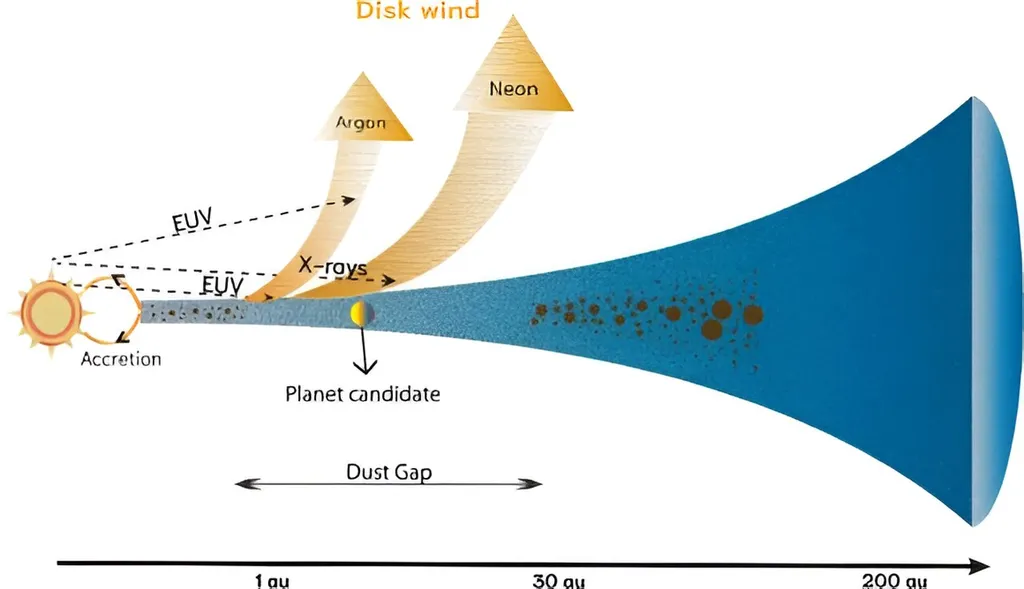
Researchers from the INAF-Astronomical Observatory of Rome, including P. Ventura, F. D’Antona, M. Tailo, and their colleagues, have published a study exploring the role of noble gases neon and argon in the chemical patterns of multiple populations in globular clusters. Their work, published in the journal Astronomy & Astrophysics, offers insights that could have implications for understanding the chemical evolution of stars and, by extension, the energy processes that drive them.
The study focuses on the destruction of sodium in models of Asymptotic Giant Branch (AGB) stars, which are a phase in the life of stars where they experience significant mass loss and nucleosynthesis. The researchers specifically examined the cluster NGC 2808, which exhibits a wide range of chemical abundances among its stars. By increasing the initial neon abundance and adjusting the mass-loss rates in their models, the researchers found that higher neon levels lead to higher sodium abundances in the AGB envelope. Lowering the mass-loss rate allowed for greater depletion of oxygen and magnesium while maintaining reasonable sodium levels.
The researchers identified a balance between lower mass-loss rates and the need to avoid excessive third dredge-up episodes, concluding that a neon abundance twice the standard value and a mass-loss rate reduced by a factor of four provided the best fit to the observed abundances in NGC 2808. This model showed better agreement with the cluster’s chemical patterns than standard models, except for the most extreme stars, which seemed to require slightly lower iron abundances. The researchers proposed that these extreme stars might have formed from material with a slightly lower metallicity, fitting within a scenario of hierarchical cluster assembly.
The study also noted that potassium abundances were higher in the extreme group of stars, but explaining this through the burning of initial argon would require a significant increase in the relevant nuclear reaction cross section. The researchers suggested that understanding the abundances of neon and argon at low metallicities could be crucial for improving models of light element abundances in globular clusters.
For the energy sector, this research underscores the importance of understanding the chemical evolution of stars, as these processes influence the lifecycle of stars and the elements they produce. This knowledge can contribute to models of stellar energy production and the distribution of elements that are vital for various energy technologies, including nuclear fusion research. While the direct practical applications for the energy industry may not be immediate, the foundational science explored in this study enhances our understanding of stellar processes, which can indirectly support advancements in energy research and technology.
This article is based on research available at arXiv.