
Francesco Sanvito, Francesco Lombardi, and Stefan Pfenninger-Lee, researchers from the University of Oxford, have conducted a study that explores the optimal deployment of smart charging technologies in Europe’s energy system. Their work, published in the journal Applied Energy, aims to address the current gaps in European charging infrastructure planning by incorporating the potential flexibility offered by smart charging technologies.
The researchers developed a cost-minimizing European energy system model that explicitly represents charging infrastructure and its associated costs. This model allows for a comparison between uncontrolled charging, vehicle-to-grid (V1G), and vehicle-to-grid operation (V2G) technologies. The study finds that V1G, which involves smart charging that can adjust to grid needs, captures the majority of system cost savings, ranging from 19 to 42 billion euros per year. This translates to a reduction of 2.2 to 4.5 percent in overall system costs and substantially decreases the infrastructure requirements for charging stations.
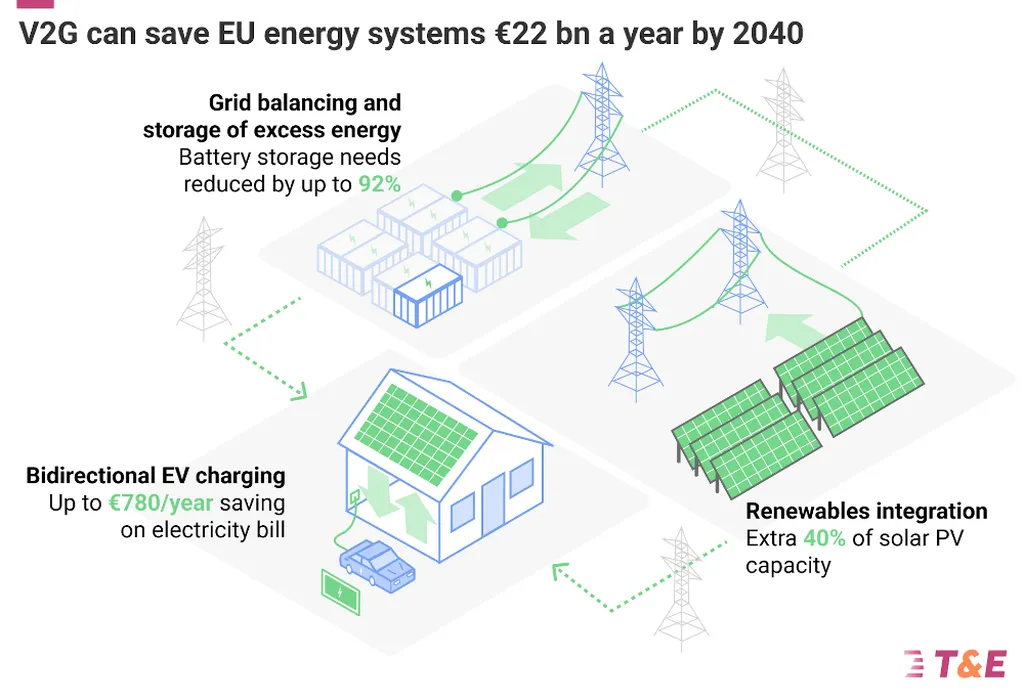
V2G, which allows electric vehicles to feed electricity back into the grid, provides more limited system cost savings of up to 2.5 billion euros per year. However, V2G generates significant balancing market revenues, amounting to around 6.4 billion euros per year. The study highlights that V2G deployment is most cost-effective in regions dominated by photovoltaic (solar) energy and in scenarios with limited grid expansion, where the combination of solar and wind generation is relatively scarce.
The research also reveals that charging infrastructure requirements vary across different countries. This variability reflects either the maximization of infrastructure utilization or the maximization of flexibility. The current uniform European Union (EU) targets for charging infrastructure risk overestimating the needs in some regions while constraining the benefits of smart charging in others. The findings suggest that a more nuanced, region-specific approach to planning charging infrastructure could optimize costs and enhance the integration of smart charging technologies into the energy system.
The practical applications of this research for the energy sector are significant. By adopting a more flexible and region-specific approach to charging infrastructure planning, energy providers and policymakers can achieve substantial cost savings and improve the overall efficiency of the energy system. The study underscores the importance of integrating smart charging technologies into the energy infrastructure to maximize their benefits and ensure a more sustainable and resilient energy future.
Source: Francesco Sanvito, Francesco Lombardi, Stefan Pfenninger-Lee. “Coordinated planning of European charging infrastructure and energy system for optimal V1G and V2G deployment.” Applied Energy, 2023.
This article is based on research available at arXiv.