
Researchers from Cornell University, including Justin Tahmassebpur, Sarvesh Chaudhari, Cristóbal Méndez, Rushil Choudhary, Sudipta Kundu, and their collaborators from other institutions, have made a significant stride in simplifying the complex landscape of inorganic solid compounds’ formation energies. Their work, published in the journal Nature Communications, presents a novel approach to understanding and predicting materials properties based solely on chemical composition.
The team focused on the convex hull of formation energies, which represents the most stable compounds for given compositions. Despite the vast number of possible atomic structures, they found that this high-dimensional space can be described remarkably simply. By training a max-affine model on data from the Materials Project density-functional theory (DFT) database, they reconstructed the convex hull using a polyhedron with only seven facets. These facets correspond to seven distinct materials classes, and just seven coefficients per element are sufficient to capture the dominant energetic trends across the composition space.
This compact, composition-only representation has far-reaching implications. Without any retraining or structural input, the model can reproduce trends in defect formation energies, capture elemental mixing correlations in high-entropy materials, and construct Pourbaix diagrams for electrochemical stability. This means that many materials properties governed by energy differences can be expressed as simple linear combinations of a small set of interpretable, element-specific parameters.
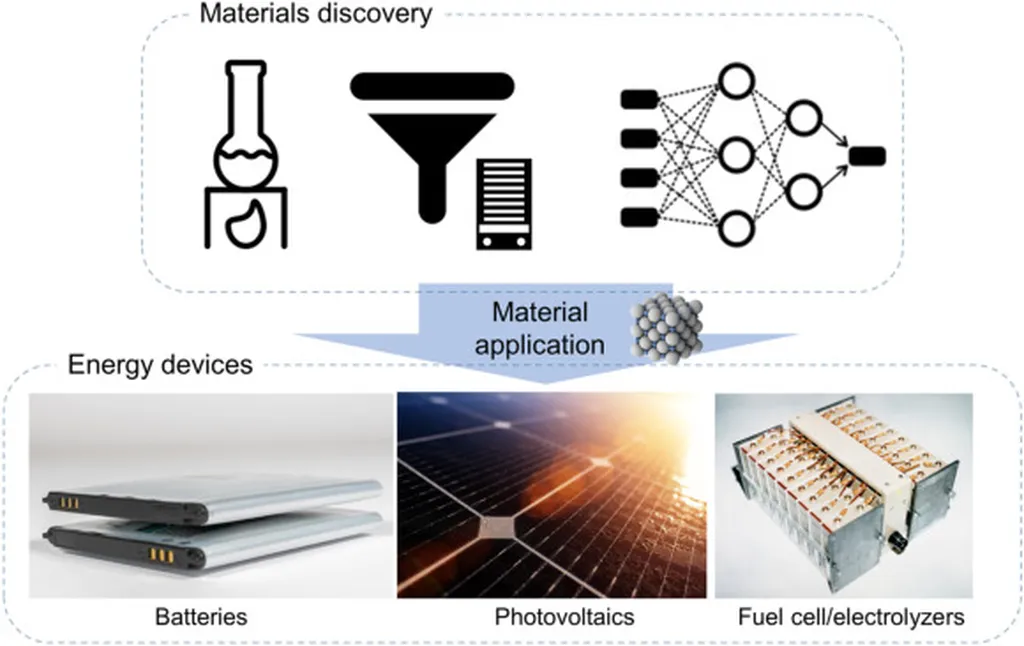
For the energy industry, this research offers a powerful tool for rapid, interpretable screening of vast chemical spaces. It enables the prediction of materials stability, defects, mixing, and electrochemical behavior based solely on composition. This can significantly accelerate the discovery and development of new materials for energy applications, such as batteries, catalysts, and solar cells. Moreover, the bonding-geometry-free thermodynamic framework unifies various materials properties, providing a comprehensive understanding that can guide experimental efforts and theoretical studies alike.
In essence, this work simplifies the complex world of materials science, offering a straightforward, efficient way to predict and understand the properties of inorganic solids. This can lead to faster, more targeted research and development in the energy sector, ultimately contributing to the creation of more efficient and sustainable energy technologies.
Source: Tahmassebpur, J., Chaudhari, S., Méndez, C. et al. A seven-facet polyhedron captures the composition-only formation-energy landscape of inorganic solids. Nat Commun 15, 385 (2024).
This article is based on research available at arXiv.