
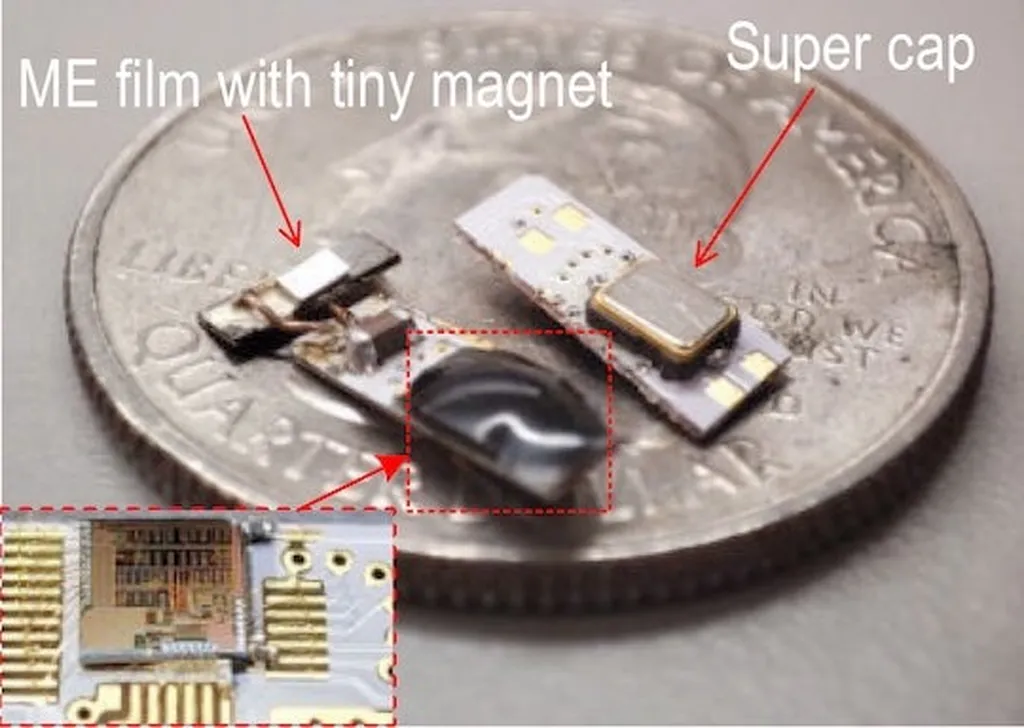
In the realm of biomedical engineering, a team of researchers from Rice University, led by Kaiyuan Yang, has developed an innovative power management unit (PMU) designed to enhance the efficiency of wireless power transfer (WPT) for millimetric biomedical implants. Their work, published in the IEEE Journal of Solid-State Circuits, addresses the challenges of powering tiny, minimally invasive medical devices without the need for bulky batteries.
The researchers have created a fully integrated PMU specifically tailored for magnetoelectric WPT systems. These systems use low-frequency acoustic-electrical coupling to transfer energy, making them suitable for extremely small receivers. The PMU is designed to maximize power extraction and usage by continuously matching the impedance of the transducer, dynamically optimizing the power stage under varying input and load conditions, and recycling stored energy to sustain the system when input power drops.
One of the key features of this PMU is its parallel-input regulation and storing stages architecture, which prevents cascading power loss. The researchers employed a skewed-duty-cycle maximum power point tracking (MPPT) technique and a regulation efficiency optimizer, achieving a peak MPPT efficiency of 98.5 percent and a peak system overall efficiency of 73.33 percent. Additionally, the PMU includes an adaptive high-voltage charging stage that can charge the stimulation capacitor up to 12 volts with an improved efficiency of 37.88 percent.
For the energy sector, this research highlights the potential for highly efficient power management in wireless systems. While the immediate application is in biomedical implants, the principles and technologies developed could inspire innovations in other areas where wireless power transfer is used, such as remote sensors and small-scale energy harvesting devices. The focus on minimizing power loss and maximizing efficiency is particularly relevant as the energy industry seeks to optimize power delivery and consumption in various applications.
The research was published in the IEEE Journal of Solid-State Circuits, a reputable source for advancements in solid-state circuits and systems. This work underscores the importance of efficient power management in enabling the next generation of wireless technologies, with potential benefits extending beyond the biomedical field into broader energy applications.
This article is based on research available at arXiv.