
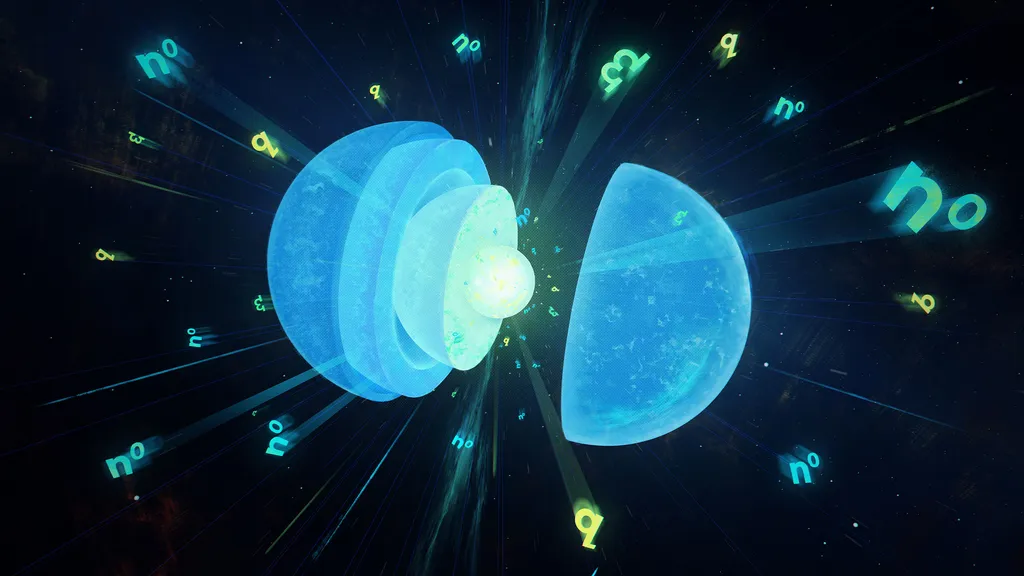
In the realm of astrophysics and energy research, understanding the behavior of proto-neutron stars (PNSs) can offer insights into the fundamental laws of gravity and the properties of matter under extreme conditions. Sayantan Ghosh, a researcher from the Indian Institute of Technology Gandhinagar, has delved into this complex subject, exploring how PNSs can serve as probes for testing the boundaries of general relativity (GR) and modified gravity theories. His findings, published in the journal Physical Review D, have implications for our understanding of neutron stars and the broader energy sector.
Proto-neutron stars are the hot, dense remnants left behind after a core-collapse supernova. They eventually cool down to become stable neutron stars. Ghosh’s study focuses on the macroscopic properties of PNSs, such as mass, radius, compactness, tidal deformability, oscillation frequencies, and gravitational binding energy. By using different relativistic mean-field equations of state (EOSs) and varying parameters like entropy per baryon and lepton fractions, Ghosh observed significant changes in these properties. This variability is crucial for understanding the life cycle of neutron stars and the conditions under which they form.
To extend the study beyond the framework of general relativity, Ghosh explored the effects of Energy-Momentum Squared Gravity (EMSG), a modified gravity theory that introduces squared energy-momentum terms into the field equations. In weak-field regimes, EMSG behaves similarly to GR, but in strong-field regimes like those found in PNSs, measurable deviations become apparent. By adjusting the free parameter α in EMSG, Ghosh found that the macroscopic properties of PNSs change significantly. Despite these changes, the correlations between different properties remained strong and nearly unaffected, suggesting a robust underlying relationship.
The practical applications of this research for the energy sector are primarily indirect but significant. Understanding the behavior of neutron stars and the fundamental laws of gravity can inform the development of advanced energy technologies, such as nuclear fusion and other high-energy processes. By probing the extreme conditions found in PNSs, researchers can gain insights into the behavior of matter and energy under similar conditions on Earth, potentially leading to breakthroughs in energy production and storage. Additionally, the study of modified gravity theories can contribute to our understanding of dark energy and dark matter, which are believed to play crucial roles in the structure and evolution of the universe.
In conclusion, Ghosh’s research provides valuable insights into the properties of proto-neutron stars and the behavior of gravity in strong-field regimes. By exploring the effects of different equations of state and modified gravity theories, the study highlights the robustness of universal relations in the macroscopic properties of PNSs. These findings contribute to our broader understanding of astrophysics and energy processes, paving the way for future advancements in the energy sector.
This article is based on research available at arXiv.