
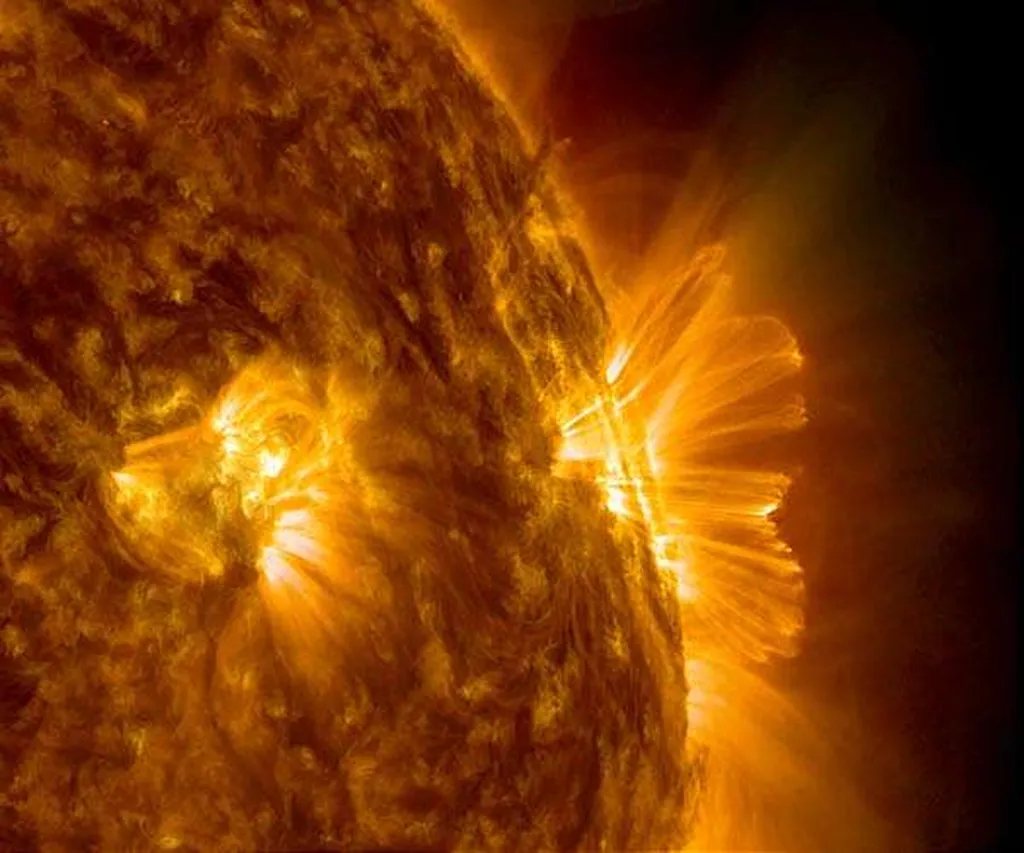
In the realm of solar physics, a team of researchers from the New Jersey Institute of Technology, led by Gregory D. Fleishman, has made a significant stride in understanding solar flares. Their study, published in the journal Nature Astronomy, sheds light on the mysterious MeV-peaked electron population in solar flares, a phenomenon that has puzzled scientists for years.
Solar flares are intense bursts of radiation emanating from the release of magnetic energy in the solar corona. They produce high-energy charged particles, both ions and electrons, which emit microwaves and X- and γ-rays. The researchers focused on a distinct γ-ray component, known as the MeV component, which dominates at MeV energies and differs from the well-studied X-ray continuum. The origin and precise location of this component have been unknown until now.
The team analyzed data from the 2017-Sep-10 solar flare using Fermi MeV γ-ray data and EOVSA spatially resolved microwave imaging spectroscopy data. They discovered that the microwave spectrum from the MeV-peaked electron population has a unique shape, distinct from that produced by the well-known population of electrons with falling energy spectrum. By inspecting microwave maps of the flare, they identified an evolving area where the measured microwave spectra matched the theoretically expected one for the MeV-peaked population. This pinpointed the site where this MeV component resides in the flare.
The locations of these MeV-peaked electrons were found to be in a coronal volume adjacent to the region where prominent release of magnetic energy and bulk electron acceleration were detected. This implies that transport effects play a key role in forming this population. Understanding these processes can provide valuable insights into the dynamics of solar flares and the behavior of high-energy particles in the solar corona.
For the energy industry, this research could have practical applications in space weather forecasting. Solar flares and the associated coronal mass ejections can significantly impact space weather, affecting satellite operations, power grids, and communication systems. A deeper understanding of the mechanisms driving solar flares can improve our predictive capabilities, helping to mitigate potential risks and damages.
In conclusion, the study by Fleishman and his team has unraveled some of the mysteries surrounding the MeV-peaked electron population in solar flares. Their findings not only advance our knowledge of solar physics but also hold promise for enhancing space weather forecasting, benefiting the energy industry and other sectors sensitive to space weather events.
This article is based on research available at arXiv.