
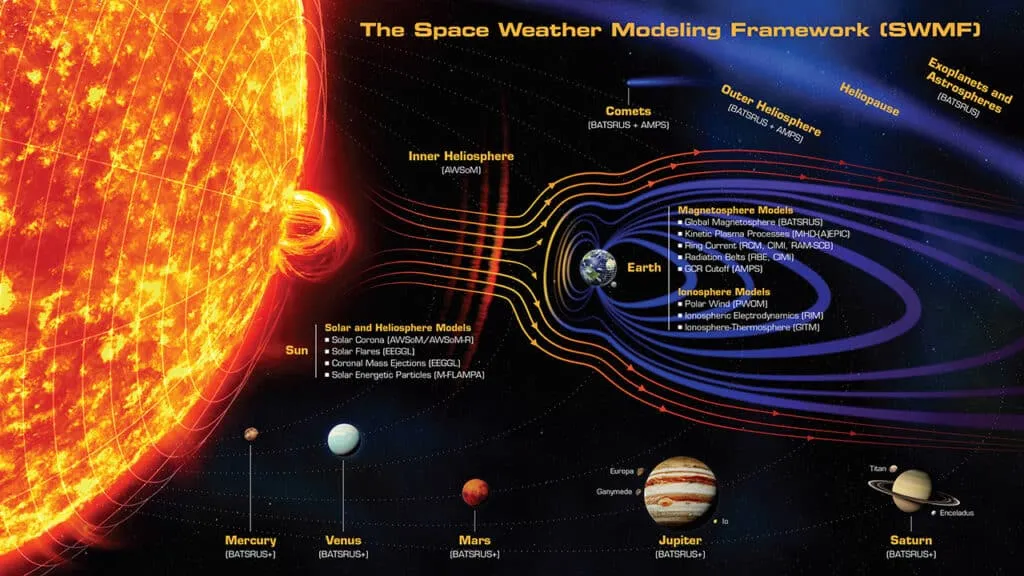
Researchers from the University of Michigan, including Nishtha Sachdeva, Zhenguang Huang, Gabor Toth, Hongfan Chen, Ward B. Manchester, and Bart van der Holst, have delved into the intricacies of solar wind conditions and their impact on coronal mass ejections (CMEs). Their work, published in the journal Space Weather, sheds light on the importance of accurate data-driven modeling for space weather prediction and operational models.
The team utilized different input magnetic field maps for the same time period to drive the global Alfven Wave Solar atmosphere Model (AWSoM). This approach allowed them to obtain ambient solar wind conditions and compare plasma properties and magnetic morphology in the coronal domain. The goal was to study the influence of the input maps on the resulting solar wind solutions, which provide the ambient plasma environment into which CMEs travel.
The researchers launched analytical flux ropes to simulate eruptions into these data-driven solutions and compared their evolution in the coronal domain, up to 24 solar radii radially. They found that the CMEs achieved varying speeds, deceleration rates, propagation directions, mass, and energies while coupling with the background solar wind. The differences were quantified to show that the input driving maps can significantly impact the simulated CME propagation in the solar wind plasma.
This study highlights the importance of understanding the uncertainties associated with data-driven modeling. Accurate modeling is crucial for operational models and space weather prediction, which are vital for protecting infrastructure and technology on Earth and in space. The energy industry, in particular, relies on space weather forecasts to mitigate potential risks to power grids and other critical infrastructure.
In summary, the research underscores the need for precise data-driven models to better predict the behavior of CMEs and their interaction with the solar wind. This understanding is essential for improving space weather forecasts and safeguarding energy infrastructure from the impacts of solar activity.
This article is based on research available at arXiv.