
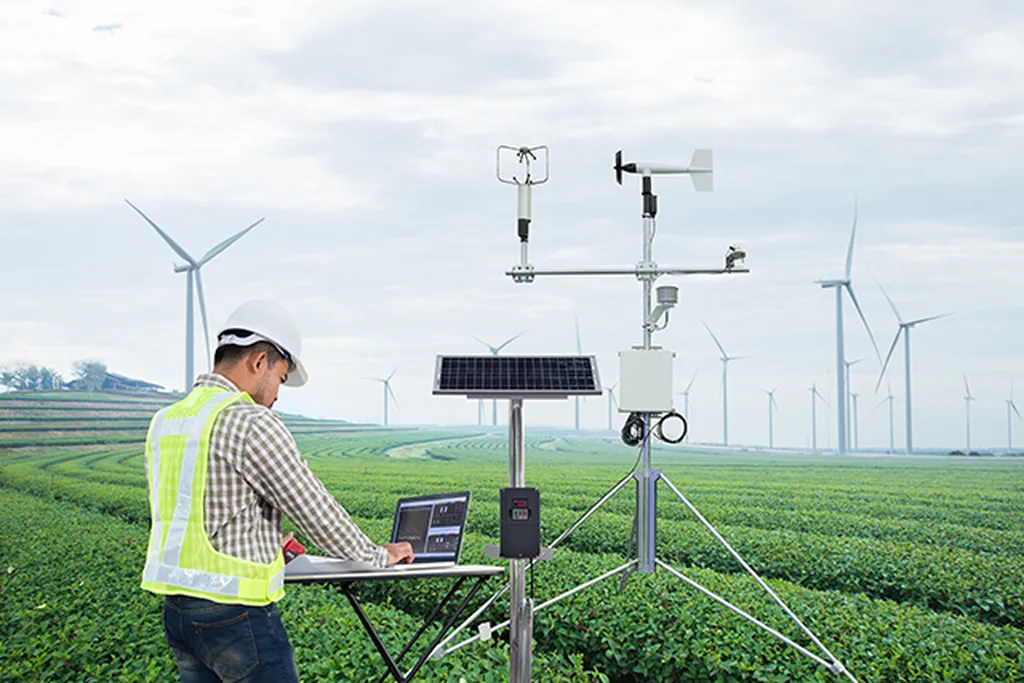
In the realm of energy and environmental research, accurate prediction of rainfall and its characteristics is crucial for various applications, including wind energy and soil conservation. Dr. R. J. Humphreys, a researcher at the University of Reading, has delved into the realm of radar-based raindrop size distribution (RSD) prediction, comparing different analytical and machine-learning approaches to improve the accuracy of these predictions.
The study, published in the journal Atmospheric Measurement Techniques, focuses on the importance of reliable RSD estimation for applications such as quantitative precipitation estimation, soil erosion modeling, and wind turbine blade erosion. While disdrometers provide detailed RSD measurements, their spatial limitations have led to the use of polarimetric radar for remote retrieval of rain microphysical properties.
Humphreys collected one-minute OTT Parsivel2 disdrometer measurements from September 2020 to May 2022 at Sheepdrove Farm, UK. These measurements were quality-controlled using collocated weighing and tipping-bucket rain gauges. The measured RSDs were then fitted to a normalized three-parameter gamma distribution, from which a range of polarimetric radar variables were analytically simulated.
The research compared analytical retrievals, neural networks, and decision tree models to estimate the gamma distribution parameters across multiple radar feature sets and model architectures. To ensure robustness and equifinality, each model configuration was trained 100 times using random 70/30 train-test splits, resulting in approximately 17,000 trained models.
The findings revealed that machine-learning approaches generally outperformed analytical methods. However, no single model class or architecture was uniformly optimal. Model performance depended strongly on both the target RSD parameter and the available radar observables. Decision trees, in particular, showed robustness in reduced-feature regimes.
For the energy sector, particularly wind energy, accurate RSD prediction is vital for assessing and mitigating wind turbine blade erosion. By understanding the size and distribution of raindrops, operators can better predict and manage the impact of rainfall on turbine blades, leading to improved maintenance strategies and increased operational efficiency. Additionally, accurate precipitation estimation is crucial for hydropower generation and overall energy planning.
This research highlights the importance of aligning retrieval model structure with operational data constraints rather than adopting a single universal approach. By leveraging machine-learning techniques, the energy industry can enhance its predictive capabilities and make more informed decisions regarding infrastructure and maintenance.
This article is based on research available at arXiv.