
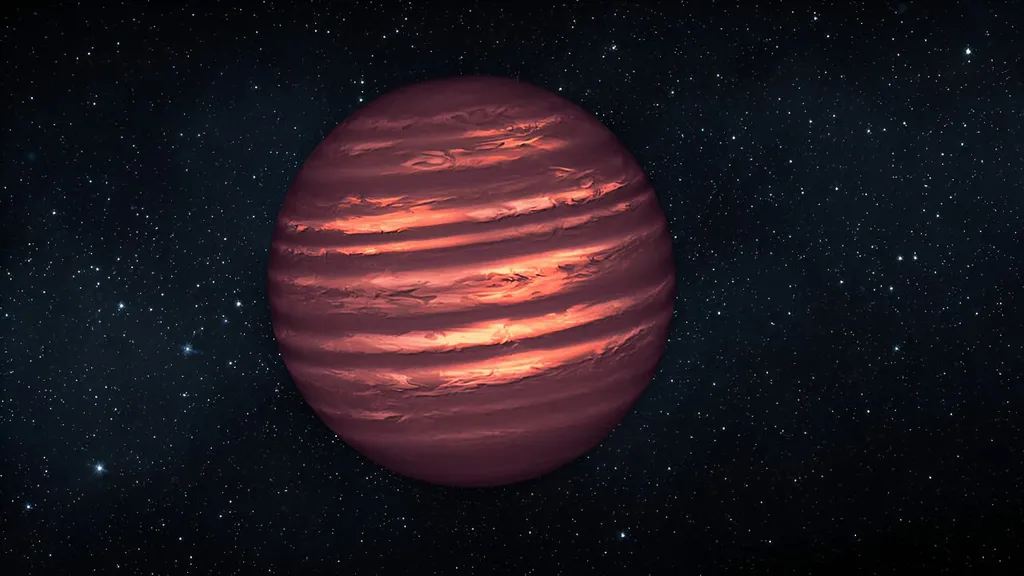
In a recent study, a team of researchers led by Dr. David Li from the University of California, Irvine, has utilized the James Webb Space Telescope (JWST) to investigate the distribution and characteristics of brown dwarfs, which are substellar objects that are not massive enough to sustain nuclear fusion like stars. The team, which includes collaborators from various institutions, conducted a deep field survey around the galaxy cluster Abell 2744 to search for these elusive objects at kiloparsec distances.
The researchers employed a two-step methodology to identify brown dwarf candidates. First, they selected objects based on their photometric colors, and then they fitted the spectral energy distributions of these candidates to both stellar atmospheric models and high-redshift galaxy templates. This approach yielded two robust T dwarf candidates and one possible L subdwarf candidate. T dwarfs are a class of brown dwarfs with effective temperatures between approximately 500 and 1,300 Kelvin, while L dwarfs are slightly warmer, with temperatures ranging from about 1,300 to 2,200 Kelvin.
The two T dwarfs identified in this study have estimated Galactic heights of 0.43 and 0.86 kiloparsecs, suggesting that they likely reside near the outer edges of the Galactic thin and thick discs, respectively. The researchers measured a surface number density of T dwarfs in the UNCOVER field of 0.094 per squared arcminute, which is lower than previous predictions but consistent at the order-of-magnitude level. They also provided space number density estimates for T5-T8.9 dwarfs across different effective temperature and spectral type bins. Notably, they found that T5-T7 dwarfs out to 2 kiloparsecs have significantly lower densities than their solar neighborhood counterparts, while T8 dwarfs within the thick disc exhibit densities comparable to local values.
The study demonstrates that broad-band near- to mid-infrared photometry provides high sensitivity to late-T dwarfs but is relatively less sensitive to L and early-T dwarfs. Spectroscopy is typically required to distinguish photometric candidates of L dwarfs, early-T subdwarfs, and high-redshift galaxies in JWST deep fields. This research, published in the journal Astronomy & Astrophysics, offers new insights into substellar populations beyond the solar neighborhood and highlights the potential of JWST for expanding our understanding of brown dwarf distributions and characteristics at unprecedented distances.
While this research may not have direct practical applications for the energy sector, it contributes to our broader understanding of the universe and the diverse range of celestial objects that inhabit it. As our knowledge of these objects grows, it may indirectly inform the development of new technologies and approaches in fields such as astrophysics, astronomy, and space exploration, which could have implications for energy generation, storage, and transmission in the future.
This article is based on research available at arXiv.