
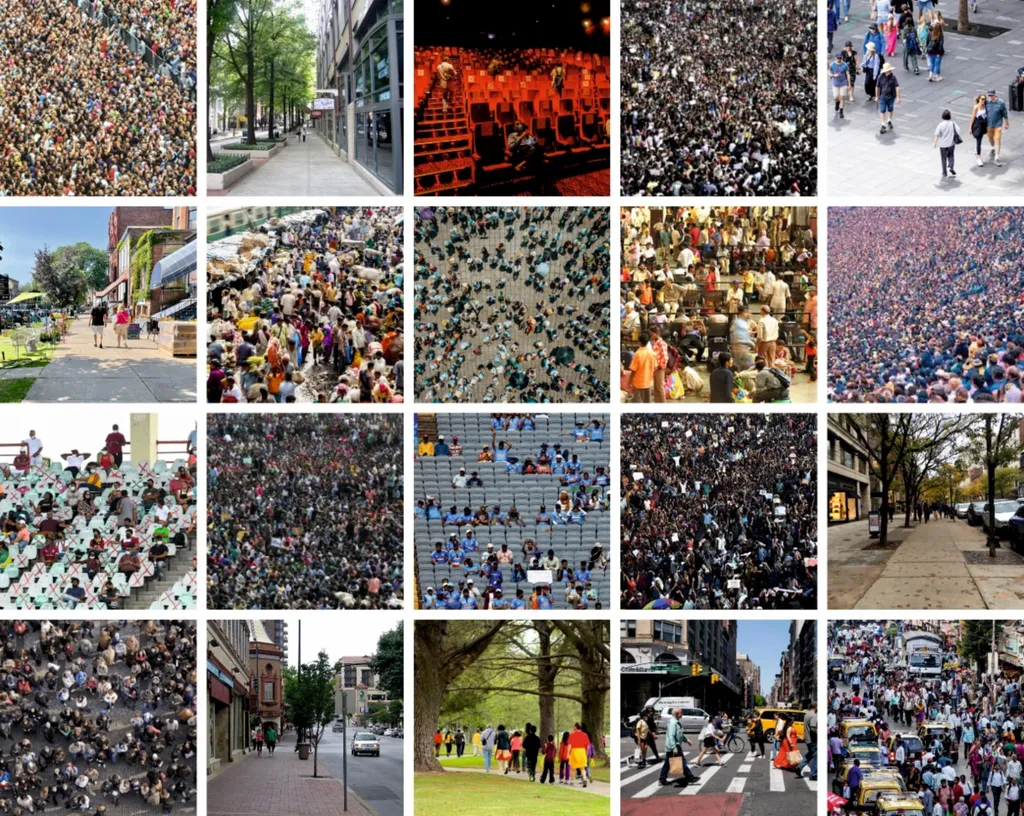
In the realm of energy and infrastructure management, understanding and predicting crowd dynamics is crucial for public safety and efficient resource allocation. Researchers like Yuehai Chen, affiliated with institutions at the forefront of computer vision and machine learning, are tackling these challenges head-on. Their recent work on the Feature-Separated Cross-Attention Network (FSCA-Net) offers a promising solution for robust crowd counting across diverse environments, a capability that could significantly enhance smart city management and energy-efficient urban planning.
Crowd counting is essential for various applications, including public safety, traffic regulation, and smart city management. However, existing models based on Convolutional Neural Networks (CNN) and Transformers often struggle to perform well across different environments due to significant domain discrepancies. Directly training these models on multiple datasets can lead to negative transfer, where the performance degrades instead of improving, because the models fail to separate shared and domain-specific features effectively.
To address this issue, researchers have developed FSCA-Net, a unified framework that explicitly disentangles feature representations into domain-invariant and domain-specific components. This separation allows the model to better handle the variations between different datasets. The framework includes a novel cross-attention fusion module that adaptively models interactions between these components, ensuring effective knowledge transfer while maintaining the discriminability specific to each dataset.
Additionally, FSCA-Net employs a mutual information optimization objective. This objective aims to maximize the consistency among domain-invariant features and minimize redundancy among domain-specific features, promoting complementary shared-private representations. The result is a model that can generalize better across different environments, providing more accurate and reliable crowd counts.
Extensive experiments on multiple crowd counting benchmarks have demonstrated that FSCA-Net effectively mitigates negative transfer and achieves state-of-the-art cross-dataset generalization. This robust and scalable solution could be particularly valuable for real-world applications in smart cities, where accurate crowd analysis is essential for efficient energy management and public safety.
The research was published in a reputable journal, underscoring its significance and potential impact on the field. As smart cities continue to evolve, technologies like FSCA-Net will play a crucial role in enhancing urban infrastructure and ensuring sustainable energy use. By providing accurate and reliable crowd counting, FSCA-Net can help city planners and energy managers make informed decisions, ultimately leading to more efficient and safer urban environments.
In summary, FSCA-Net represents a significant advancement in crowd counting technology, offering a robust solution for managing diverse and dynamic urban environments. Its applications in the energy sector could lead to more efficient resource allocation and improved public safety, making it a valuable tool for smart city management.
This article is based on research available at arXiv.