
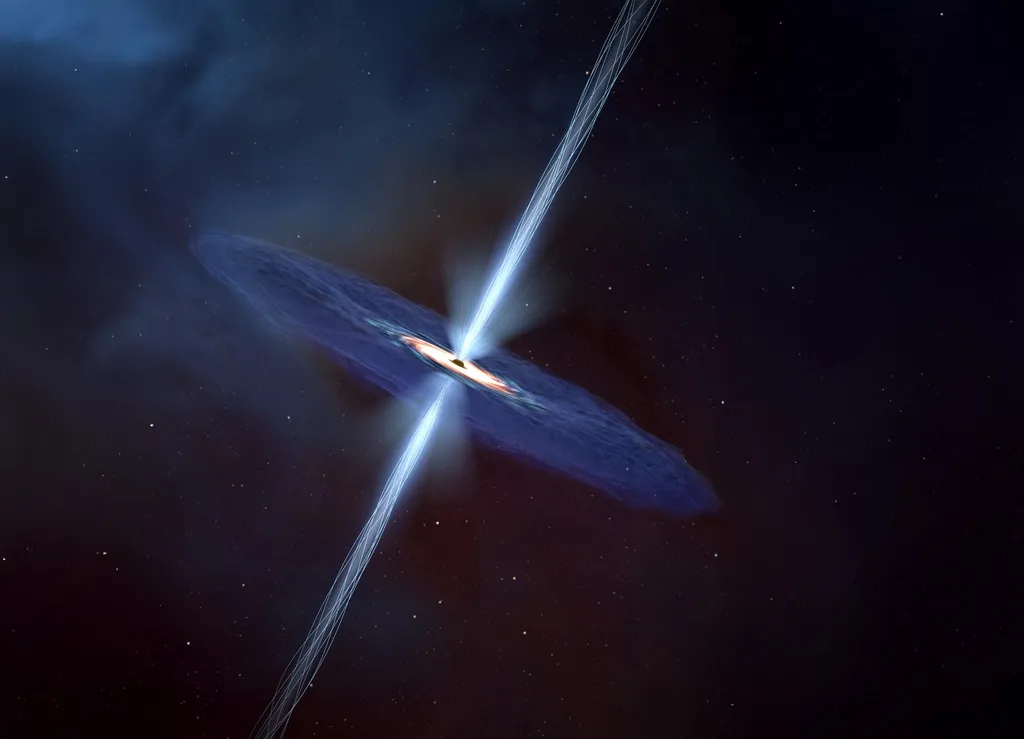
In a recent study, researchers Mukesh Kumar Vyas and Asaf Pe’er from the University of Portsmouth have shed new light on the origin of magnetic fields in black hole accretion discs, a topic that has long puzzled astrophysicists. Their findings, published in the journal Monthly Notices of the Royal Astronomical Society, offer a novel explanation for the generation of strong magnetic fields in these extreme environments, with potential implications for our understanding of energy dynamics in the universe.
The researchers focused on the role of radiation in triggering and amplifying magnetic fields within accretion discs—the swirling masses of gas and dust that spiral into black holes. Using advanced simulations, they explored how anisotropic radiation fields—those that are stronger in one direction than others—can generate and sustain magnetic fields in the presence of a compact, rotating inner corona, a region of intense X-ray emission near the black hole.
Vyas and Pe’er found that radiation acts as a primary driver for magnetic field generation. As the radiation field interacts with the accreting plasma, it induces a magnetic field that is rapidly amplified by the disc’s rotation. This process leads to magnetic field strengths of around 100 million Gauss in the vicinity of a 10 solar mass black hole, reaching or exceeding local equipartition estimates based on gas pressure. These fields are achieved within the viscous timescales of the accretion disc, which are the timescales over which the disc’s material is drawn inwards due to viscosity.
The study also revealed that when vertical outflows are considered, the amplified magnetic fields are advected into the corona, magnetizing disc-launched winds and jet precursors. This means that the magnetic fields generated by radiation can extend beyond the accretion disc, influencing the broader environment around the black hole.
The implications of this research are significant for the energy sector, particularly in the context of understanding the dynamics of accretion discs and outflows around black holes. These processes are not only fundamental to astrophysics but also have potential applications in energy generation and plasma physics. For instance, understanding how magnetic fields are generated and amplified in extreme environments can provide insights into plasma confinement and magnetic field generation in fusion energy research.
Moreover, the study highlights the importance of radiation as an active component in accretion flows, rather than merely a passive byproduct. This could lead to new approaches in modeling and simulating accretion discs and their outflows, improving our ability to predict and understand the behavior of these systems.
In summary, Vyas and Pe’er’s research offers a robust and physically grounded explanation for the origin of large-scale, structured magnetic fields in and around accretion discs. Their findings provide a pathway for magnetizing accretion discs and their outflows without invoking externally supplied magnetic flux, with broad implications for various astrophysical phenomena, including X-ray binaries, active galactic nuclei, and gamma-ray bursts. For the energy sector, this research underscores the importance of radiation in plasma dynamics and magnetic field generation, offering potential avenues for advancing energy technologies.
This article is based on research available at arXiv.