
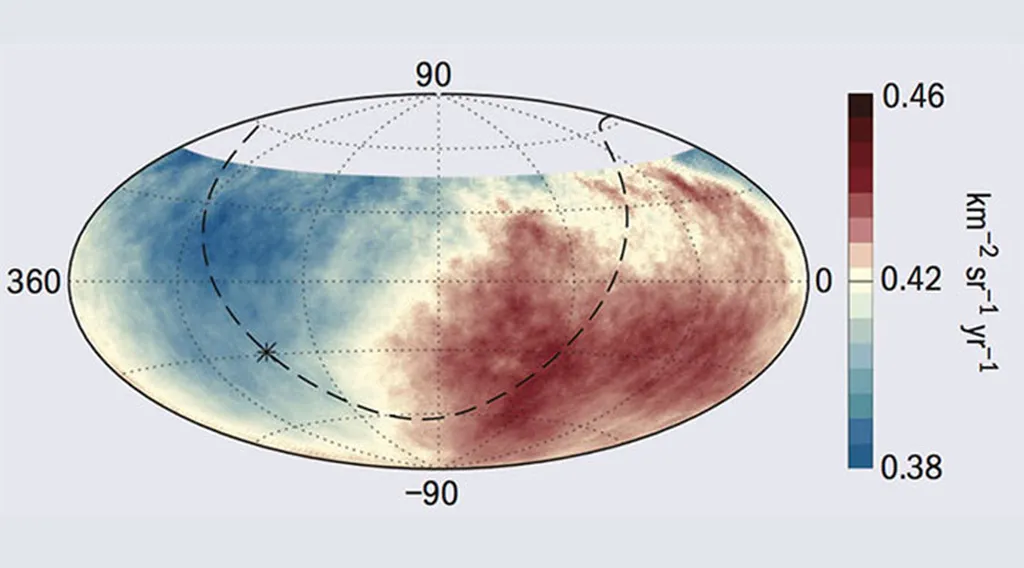
The Pierre Auger Collaboration, a global group of researchers affiliated with the Pierre Auger Observatory, has recently conducted a study to search for ultra-high energy neutrons from Galactic sources. The collaboration includes numerous scientists from various institutions, with the Pierre Auger Observatory being a key facility for their research.
The study focuses on the challenge of identifying the sources of ultra-high-energy cosmic rays (UHECRs) due to deflections caused by magnetic fields. Unlike charged UHECRs, neutrons travel in straight lines, pointing directly to their origin. The researchers hypothesized that UHECR emissions from a source would be accompanied by neutron production, making it possible to detect a neutron flux from Galactic sources on Earth.
Using data from the Phase I of the Surface Detector of the Pierre Auger Observatory, the researchers searched for neutron fluxes from over 1000 astrophysical objects of interest. These targets were stacked into sets and analyzed for any significant excess of events that could indicate a neutron flux. The analysis covered declinations within the Observatory’s exposure, ranging from -90° up to +45° for energies above 1 EeV, and up to +20° for energies down to 0.1 EeV.
The researchers found no significant excess at any tested target direction, leading to the calculation of upper limits on the neutron flux for each candidate source. This result provides valuable insights into the nature of UHECR sources and their associated neutron emissions. The study was published in the journal Physical Review D.
In practical terms for the energy sector, understanding the origins and behavior of UHECRs and their associated neutrons can have implications for space-based solar power systems, satellite technology, and even nuclear energy research. The ability to detect and analyze neutron fluxes can contribute to the development of more robust and resilient energy infrastructure, particularly in space applications where exposure to cosmic rays is a significant concern. Additionally, the research can inform the design of shielding and protective measures for energy systems operating in high-radiation environments.
This article is based on research available at arXiv.