
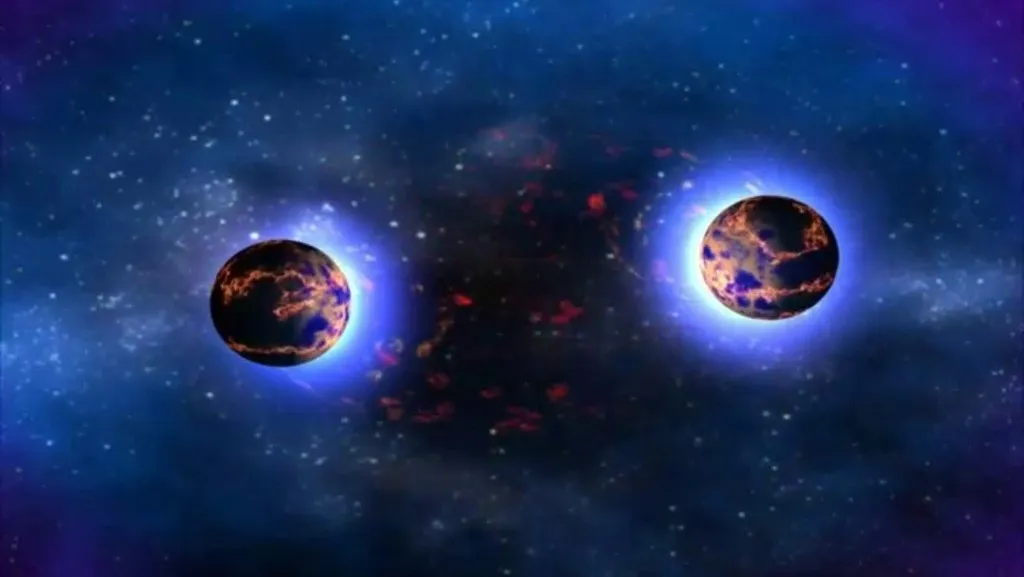
In the realm of astrophysics and gravitational wave research, a team of scientists from the University of Virginia and the University of Barcelona has made strides in understanding the detectability of certain phenomena during binary neutron star or neutron star-black hole mergers. The researchers, Alberto Revilla-Peña, Ruxandra Bondarescu, Andrew P. Lundgren, and Jordi Miralda-Escudé, have published their findings in the journal Physical Review D.
The team focused on the detectability of low-lying dynamical tides in these binary systems. During the inspiral phase, tidal forces can excite oscillatory modes in one or both of the stars. When the orbital frequency of the binary system sweeps through the resonant mode frequency, energy is dissipated into the vibrational mode, causing a slight advance in the merger time. This effect can lead to a mismatch when fitting the observed gravitational wave signal to a model that does not account for this resonance.
To quantify this effect, the researchers computed the mismatch for current and planned detectors using two different methods: a quasi-analytical approach and an optimized version of the standard numerical match function. They found that detectability can occur for time advances of around 1 millisecond with advanced LIGO-Virgo-KAGRA (LVK) detectors, given an excess energy-flux that is a few percent of the gravitational wave emission.
Their results challenge previous work that modeled this effect solely as a phase shift of the waveform or used the difference in the number of cycles induced by the resonant behavior. The researchers demonstrated that tidal resonance effects primarily cause a time advance of the merger, rather than a phase difference. Additionally, they showed that the single-frequency approximation commonly used in the literature significantly overestimates the detectability of this effect.
For the energy sector, particularly in the realm of energy harvesting from space-based systems or advanced energy storage technologies, understanding these astrophysical phenomena can provide insights into the fundamental physics of gravitational waves and their interactions with matter. This research could potentially contribute to the development of more accurate models for energy dissipation and transfer in extreme astrophysical environments, which could have implications for future energy technologies. However, the direct practical applications for the energy industry are still speculative and would require further exploration and development.
This article is based on research available at arXiv.