
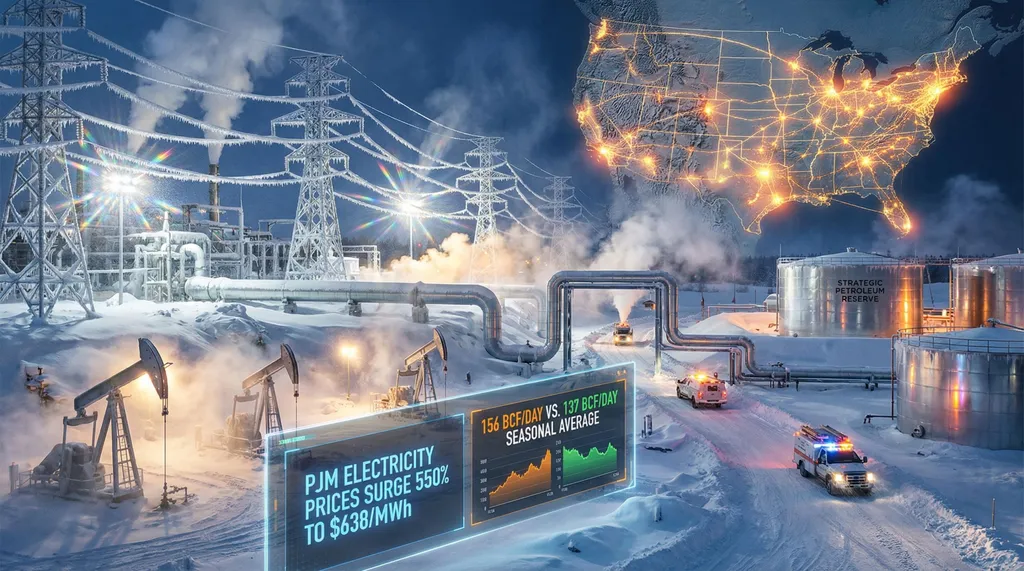
Winter Storm Fern’s impact on US energy markets has laid bare the intricate vulnerabilities of America’s electricity infrastructure during extreme weather events. The storm’s operational response revealed coal’s unique strategic position within the generation portfolio, with output surging from approximately 70 GWh daily to roughly 130 GWh during peak conditions. This near-doubling of capacity, while natural gas generation increased by only 14%, underscores fundamental differences in emergency response capabilities between fuel sources.
The crisis exposed how extreme weather creates cascading failures across multiple energy systems simultaneously. It demonstrated the interconnected nature of energy transition challenges facing modern grid operators during peak demand and constrained supply. Coal’s operational advantages during such periods—fuel security, price stability, rapid activation, and weather resistance—became particularly valuable when alternative fuel sources faced supply constraints. The 31% increase in coal generation during the storm represents the activation of existing capacity, indicating that coal units remain operationally ready despite ongoing retirement discussions.
The Department of Energy’s Section 202(c) emergency orders during Winter Storm Fern revealed the regulatory framework governing crisis response across multiple Regional Transmission Organizations. The fact that orders were issued across three separate RTOs simultaneously demonstrates that the storm created system-wide rather than localised stress, requiring coordinated response across interconnected grid regions. These emergency orders temporarily suspend Clean Air Act compliance requirements, allowing generators to operate beyond normal environmental limits when reliability is threatened. The decision-making process involves complex cost-benefit calculations that compare operating costs of higher-emission backup generation against environmental compliance trade-offs during crisis periods.
The storm also highlighted critical infrastructure vulnerabilities, particularly in natural gas markets, where spot prices reached an all-time high of $30.565/MMBtu during peak conditions. This price explosion resulted from pipeline freeze-offs, residential heating priority, supply-demand mismatch, and storage depletion. The price volatility directly transmitted to electricity markets, particularly in New England, where electricity prices are closely tied to natural gas pricing. This coupling creates a transmission mechanism where fuel market disruptions immediately impact retail electricity costs, amplifying economic stress during crisis periods.
Weather-dependent generation sources, including solar, wind, and hydropower, experienced predictable but significant output declines during the storm. Solar generation faced challenges from heavy cloud cover, snow accumulation, reduced daylight hours, and ice formation on tracking systems. Wind generation experienced variability due to extreme wind speeds, ice formation on turbine blades, grid integration challenges, and maintenance access limitations.
The recurring pattern of extreme weather events requiring emergency coal deployment raises fundamental questions about America’s energy transition strategy. Similar coal mobilisation occurred during severe cold snaps in February 2021 and January 2025, establishing a five-year pattern of weather-driven reliability challenges that suggest structural rather than anomalous vulnerabilities. This pattern underscores the importance of oil price movements and their impact on backup generation economics during crisis periods.
Grid operators face competing pressures between environmental objectives and reliability requirements, particularly as extreme weather events become more frequent and severe. Key factors influencing coal retirement decisions include emergency capacity value, fuel security advantages, infrastructure replacement costs, regulatory compliance burden, and market design limitations. The challenge lies in quantifying the economic value of insurance capacity that operates infrequently but provides critical services during extreme events. Traditional market mechanisms often undervalue reliability services because they focus on energy production rather than availability during crisis periods.
Winter Storm Fern’s impact patterns are driving investment toward technologies and infrastructure designs that maintain performance during adverse conditions. Dual-fuel capability development and energy storage deployment offer potential solutions for bridging short-term supply disruptions. However, their effectiveness during extended extreme weather events remains limited by current technology constraints.
The storm’s implications for markets are profound. It has sparked a debate about the balance between environmental goals and grid reliability, the role of coal in the energy transition, and the need for market mechanisms that adequately value reliability services. As extreme weather events become more frequent and severe, the lessons from Winter Storm Fern will shape the development of America’s energy sector, driving investments in weather-resilient technologies and infrastructure designs that can withstand the challenges of a changing climate.