
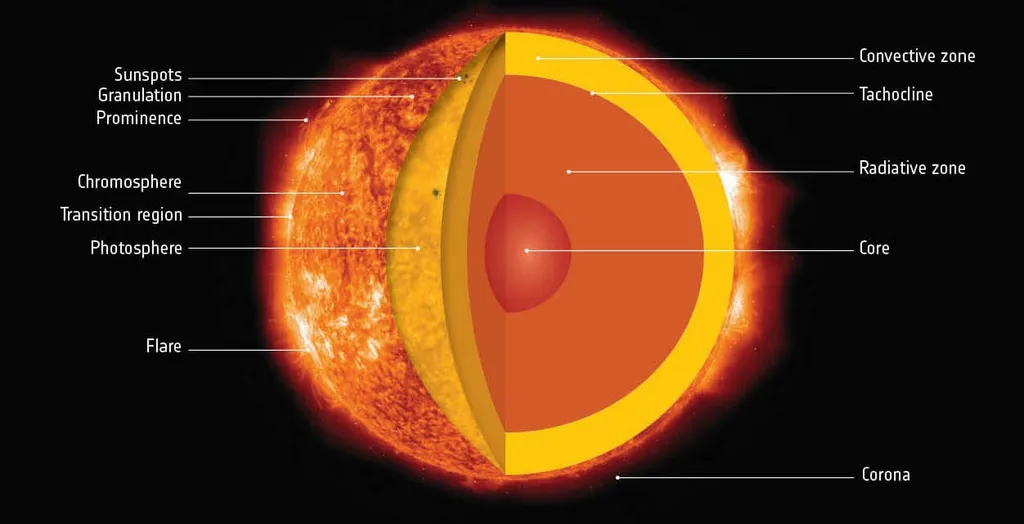
In the realm of solar physics, researchers like Dr. Benjamin Snow and Dr. Andrew Hillier from the University of Exeter are delving into the intricate dynamics of the solar atmosphere. Their recent study, published in the journal Nature Astronomy, sheds light on the behavior of cool, dense material within the hot, tenuous solar corona, offering insights that could potentially influence our understanding of plasma behavior in fusion energy systems.
The solar corona, the outermost part of the sun’s atmosphere, is typically much hotter than the layers beneath it, a phenomenon that has puzzled scientists for decades. Within this scorching environment, cooler, denser material often appears in the form of prominences, spicules, and coronal rain. Both the cool material and the surrounding corona are relatively stable, with their local radiative losses occurring over long timescales compared to the dynamics at play. However, as the solar atmosphere evolves, it drives mixing between these cool condensations and the hot corona, leading to the formation of intermediate temperatures that can become highly efficient at radiating energy.
Snow and Hillier’s study focuses on this mixing process, particularly the shear-driven Kelvin-Helmholtz Instability (KHI) that occurs between cool condensations and the hot solar corona. Through a 3D radiative magnetohydrodynamic (MHD) simulation, they observed that thermal instabilities naturally form within the mixing layer. These instabilities grow over time, producing long, narrow structures that extend perpendicular to the magnetic field. The thermal instabilities arise spontaneously within the mixing layer as small, isolated events, and are then stretched by the background flows to create long structures in relatively narrow planes.
The turbulent flows within the solar atmosphere agitate the condensations, causing them to fragment and create smaller, localized clumps of cool, dense material. These clumps can merge and further fragment, contributing to the dynamic nature of the solar corona. Importantly, the thermal instabilities observed in the simulation act to replenish the cool, dense material lost due to mixing, maintaining an approximately constant total mass of cool material over time. The study also found that thermal instabilities account for 15-20% of all radiative losses in the turbulent plasma.
For the energy sector, particularly in the field of fusion energy, understanding the behavior of plasma and the processes that lead to energy loss is crucial. The insights gained from this study could potentially inform the development of more efficient fusion reactors, where plasma confinement and stability are paramount. By studying the sun, the ultimate plasma physics laboratory, researchers can glean valuable information that may help harness fusion energy here on Earth.
In summary, Snow and Hillier’s research provides a detailed look at the thermal instabilities and mixing processes within the solar corona. Their findings not only advance our understanding of solar physics but also offer practical implications for the energy industry, particularly in the pursuit of sustainable fusion energy.
This article is based on research available at arXiv.