
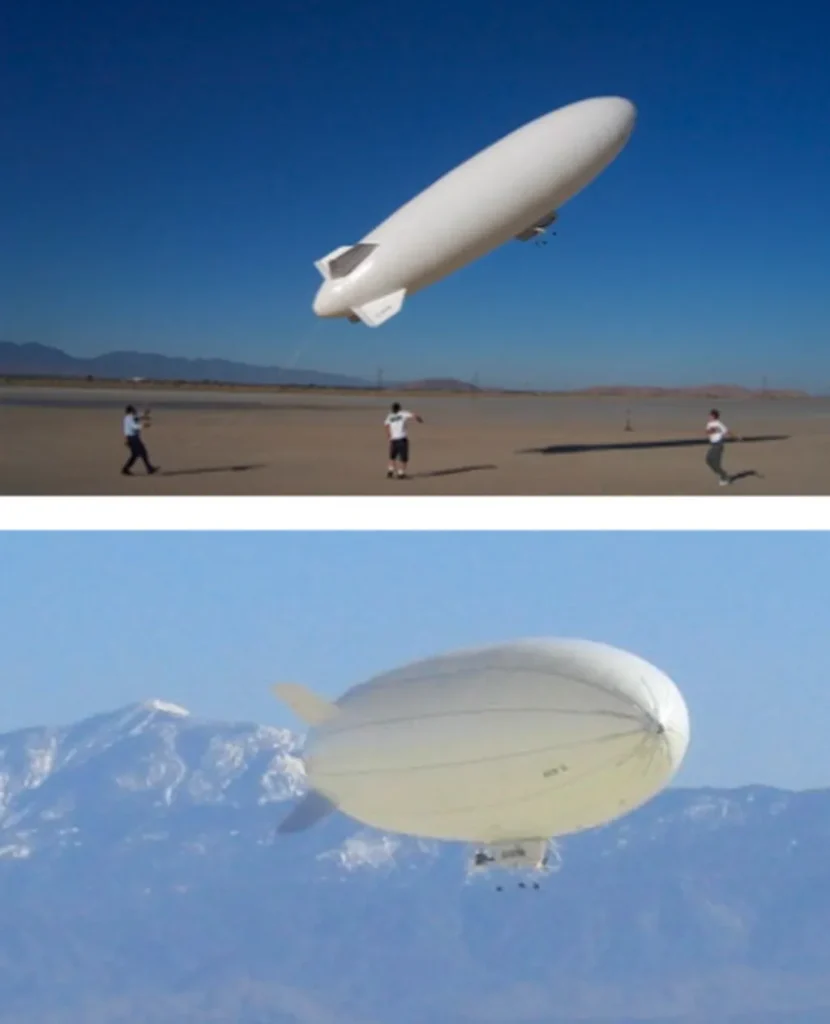
Researchers Hao Cheng and Feitian Zhang from the University of California, Berkeley have developed a new control system for robotic blimps that improves their stability and maneuverability in windy conditions. Their work, published in the journal IEEE Transactions on Control Systems Technology, focuses on enhancing the practical applications of lighter-than-air (LTA) aerial systems in the energy sector and beyond.
Robotic blimps offer several advantages for the energy industry, including long endurance and safe operation, making them suitable for tasks such as inspecting power lines, monitoring renewable energy infrastructure, and assessing environmental impacts. However, their susceptibility to wind disturbances has limited their widespread adoption. Cheng and Zhang’s research addresses this challenge by explicitly modeling and compensating for wind-induced effects.
The researchers developed a disturbance-aware control framework that combines a moving horizon estimator (MHE) with a model predictive controller (MPC). The MHE infers real-time wind perturbations, providing these estimates to the MPC, which then enables robust trajectory and heading regulation under varying wind conditions. This approach leverages a two-degree-of-freedom (2-DoF) moving-mass mechanism to generate both inertial and aerodynamic moments for attitude and heading control, thereby enhancing flight stability in disturbance-prone environments.
Extensive flight experiments conducted under headwind and crosswind conditions demonstrated that the integrated MHE-MPC framework significantly outperforms baseline PID control. This improvement in flight stability and maneuverability makes robotic blimps more practical for use in the energy sector, where they can perform critical tasks more efficiently and safely.
The practical applications of this research extend beyond the energy industry. The disturbance-aware control framework can be applied to other aerial systems that operate in challenging environments, improving their overall performance and reliability. As the energy sector continues to evolve, the development of advanced control systems for aerial platforms will play a crucial role in enhancing the efficiency and safety of various operations.
Source: IEEE Transactions on Control Systems Technology
This article is based on research available at arXiv.