
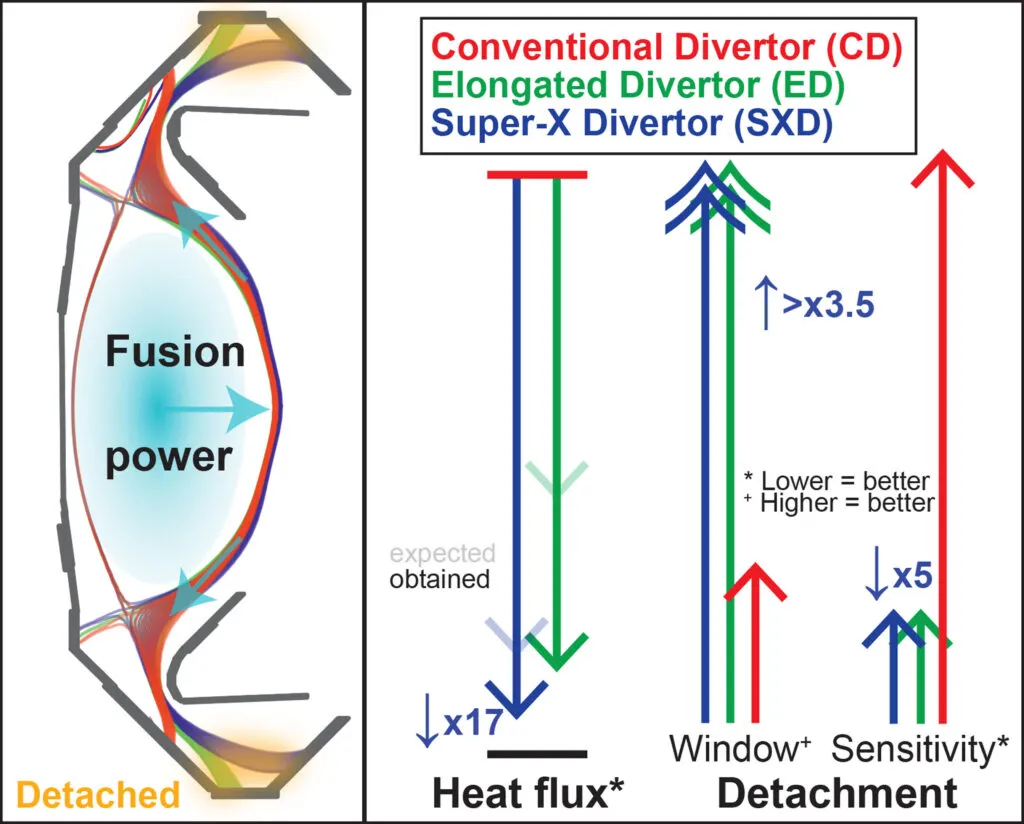
In the realm of energy research, a team of scientists led by N. Lonigro from the EUROfusion Tokamak Exploitation Team and the MAST Upgrade Team has been exploring innovative approaches to improve plasma exhaust in tokamak reactors. Their recent work, published in the journal Nuclear Fusion, focuses on a novel divertor configuration called the X-point-target (XPT) divertor, tested on the Mega Amp Spherical Tokamak Upgrade (MAST-U) facility.
The researchers conducted high-power H-mode experiments using the XPT configuration, which combines elements of the Super-X divertor (SXD) with an additional X-point near the separatrix in the outer divertor chambers. This unique geometry aims to enhance plasma-neutral interactions, leading to improved exhaust capabilities.
The experiments revealed that the XPT configuration indeed broadens the electron density profile near the secondary X-point, resulting in increased plasma-neutral interactions. This was evidenced by a broader hydrogenic emission profile, which in turn led to larger power and ion sinks. Consequently, the target electron temperatures and heat fluxes were reduced. These benefits were also observed during transients, with preliminary evidence suggesting improved ELM (Edge Localized Mode) buffering in the XPT configuration.
The practical implications for the energy sector are significant. The XPT divertor configuration could potentially enhance the performance of future fusion reactors by improving momentum, power, and particle losses. This is particularly crucial for handling the challenging exhaust conditions expected in next-generation reactors. The research highlights the potential of combining multiple alternative divertor strategies to optimize plasma exhaust, paving the way for more efficient and sustainable fusion energy solutions.
The findings were published in the journal Nuclear Fusion, providing a valuable contribution to the ongoing efforts in advancing fusion energy technology.
This article is based on research available at arXiv.