
Researchers from the Technion-Israel Institute of Technology, Weizmann Institute of Science, and the National Institute for Materials Science in Japan have made a significant advancement in quantum optics, demonstrating cooperative emission from quantum emitter ensembles in hexagonal boron nitride (hBN) layers at room temperature. This breakthrough could have practical applications in the energy sector, particularly in developing advanced lighting and quantum technologies.
The team, led by Igor Khanonkin and Meir Orenstein from the Technion-Israel Institute of Technology, utilized confocal microscopy and a Hanbury Brown-Twiss (HBT) configuration to study quantum emitters in hBN layers. They found that when these emitters are nearly indistinguishable and positioned within a sub-wavelength proximity, they exhibit collective emission behaviors. This phenomenon was observed without the need for optical cavities or cryogenic cooling, making it a scalable and practical solution for solid-state platforms.
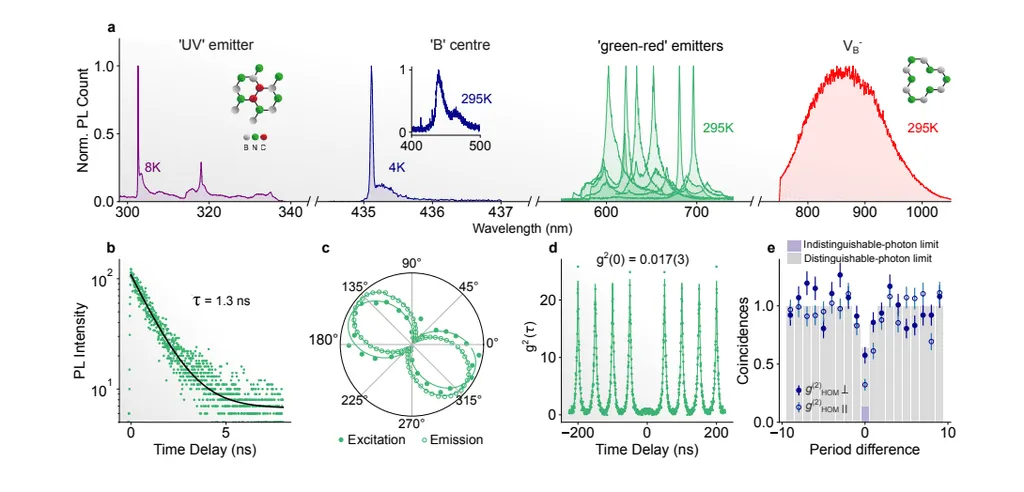
The researchers identified both isolated emitters and ensembles activated by localized electron-beam irradiation. Time-resolved photoluminescence measurements revealed a superlinear intensity enhancement and a pronounced acceleration of the radiative decay in tightly confined ensembles. The lifetimes of these ensembles approached the temporal resolution of their experimental system (about 500 ps), compared to approximately 1.85 ns for single emitters or large, spatially extended ensembles. Complementary second-order photon-correlation measurements exhibited sub-Poissonian antidips, consistent with emission from a few indistinguishable emitters.
The simultaneous observation of lifetime shortening and enhanced emission provides direct evidence of cooperative emission at room temperature. This breakthrough establishes optically active defect ensembles in hBN as a scalable solid-state platform for engineered collective quantum optics in two-dimensional materials. The research opens avenues toward ultrabright superradiant light sources and nonclassical photonic states for quantum technologies, which could have significant implications for the energy sector, particularly in developing advanced lighting solutions and quantum-based energy systems.
The research was published in the journal Nature Communications, a reputable source for scientific research across various disciplines. This study represents a significant step forward in quantum optics and could pave the way for innovative applications in the energy industry.
This article is based on research available at arXiv.