
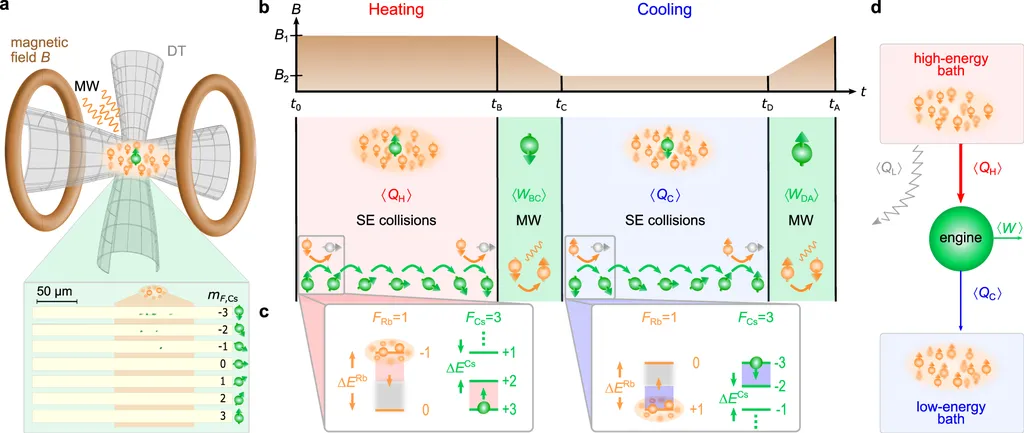
In the realm of energy research, a team of scientists from the University of Freiburg, including Salvatore Gatto, Alessandra Colla, Heinz-Peter Breuer, and Michael Thoss, have delved into the quantum world to explore a novel approach to thermodynamics that could have significant implications for the energy industry. Their work, published in the journal Physical Review Letters, focuses on the quantum Otto cycle within the framework of the single-impurity Anderson model.
The researchers investigated the thermodynamic performance of a periodic quantum Otto cycle, a quantum analog of the classical Otto cycle used in many heat engines. By employing a decomposition of the time-evolution generator based on the principle of minimal dissipation, combined with the numerically exact hierarchical equations of motion (HEOM) method, they analyzed various operating regimes of the quantum thermal machine. Their study particularly examined the effects of Coulomb interactions, strong system-reservoir coupling, and energy level alignments.
The findings reveal that Coulomb interactions, which are the electrostatic interactions between electrons, can significantly influence the operating regimes of the quantum Otto cycle. Interestingly, these interactions may lead to an enhancement of the efficiency of the cycle. This discovery is crucial as it opens up new avenues for improving the performance of quantum heat engines, which could potentially be used in various energy applications.
One of the practical applications of this research could be in the development of more efficient quantum heat engines. These engines could be used in power generation, where even small improvements in efficiency can lead to significant energy savings. Additionally, the insights gained from this study could be applied to the design of quantum refrigerators, which are essential for cooling quantum devices and maintaining their optimal operating conditions.
In summary, the research conducted by Gatto, Colla, Breuer, and Thoss provides a deeper understanding of the quantum Otto cycle and its potential for enhancing the efficiency of quantum thermal machines. This work not only advances our fundamental knowledge of quantum thermodynamics but also paves the way for practical applications in the energy sector, contributing to the development of more efficient and sustainable energy technologies.
This article is based on research available at arXiv.