
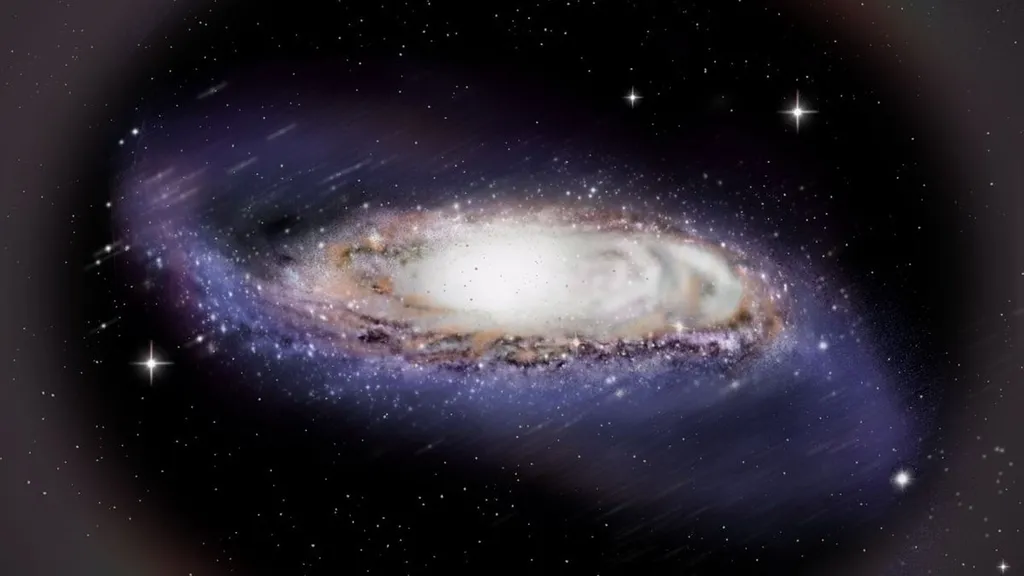
In the realm of astrophysics, a team of researchers from the National Astronomical Observatories of the Chinese Academy of Sciences, led by Mingji Deng, has been delving into the dynamics of our Milky Way galaxy. Their recent study, published in the Monthly Notices of the Royal Astronomical Society, explores the evolution of the Milky Way’s disk warp, a phenomenon that has been linked to galaxy mergers.
The research builds upon previous studies that have shown disk warps can result from galaxy mergers. The team’s focus is on the Milky Way’s rotation curve, which has shown a noticeable decline, suggesting the need for a new low-mass model to describe its dynamical features. To this end, they constructed a new Gaia-Sausage-Enceladus (GSE) merger model to characterize the rotation curve features of our galaxy.
Using the GIZMO code, the researchers simulated mergers with various orbital parameters to investigate how the disk warp evolves under different conditions. Their simulations demonstrated that the disk warp arises due to the asymmetric gravitational potential of the dark matter halo, a phenomenon universally generated by galaxy mergers. The results indicated that the tilt angle of the dark matter halo partly reflects the gravitational strength at the Z=0 plane, while the gravitational strength on the disk plane reflects the amplitude of the disk warp.
The study identified a dual-regime interaction mechanism driven by the asymmetric halo potential. On short timescales, there is a distinct anti-correlation between the halo’s tilt angle and the disk’s warp amplitude, indicating a ‘seesaw’ mechanism of angular momentum exchange. On secular timescales, however, dynamical friction drives a global alignment, causing both the halo tilt and the warp amplitude to decay simultaneously.
Furthermore, the researchers demonstrated that high-inclination mergers can sustain long-lived prograde precession. In this scenario, the persistent yet decaying gravitational torque maintains the prograde bending mode against differential wind-up.
While this research is primarily focused on astrophysics, it has potential implications for the energy sector, particularly in the field of space-based solar power. Understanding the dynamics of the Milky Way and the effects of galaxy mergers can provide valuable insights into the long-term stability and positioning of space-based solar power systems. This knowledge can aid in the design and deployment of such systems, ensuring their efficiency and longevity in the harsh environment of space.
In conclusion, the study by Mingji Deng and his team sheds new light on the evolution of the Milky Way’s disk warp, providing a deeper understanding of the dynamics of our galaxy. Their findings have the potential to inform and improve space-based energy projects, contributing to the advancement of renewable energy technologies.
This article is based on research available at arXiv.