
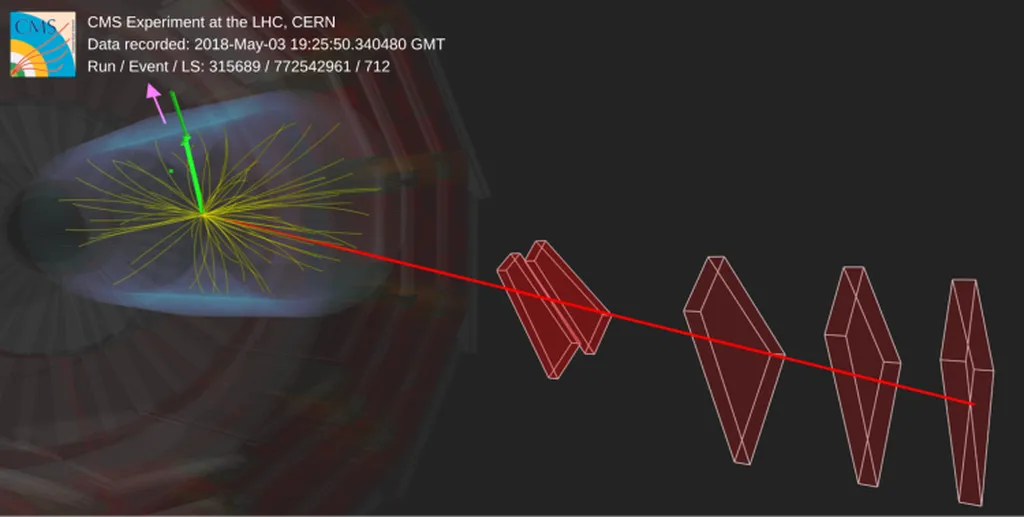
The CMS Collaboration, a group of international researchers working with the Compact Muon Solenoid (CMS) detector at the Large Hadron Collider (LHC), has recently published a study on the production of W boson pairs through a process known as photon fusion. This research, appearing in the journal Physical Review Letters, provides a precise measurement of this rare phenomenon and offers insights into the fundamental forces governing particle interactions.
The study focuses on the production of W boson pairs (W^+W^-) via photon fusion, a process where two photons interact to produce these heavy particles. Using data collected from proton-proton collisions at a center-of-mass energy of 13 TeV between 2016 and 2018, the researchers measured the total and fiducial production cross sections. The total cross section, which accounts for all possible production events, was found to be 643 ± 78 fb (femtobarns), while the fiducial cross section, which considers only events within a specific detector acceptance, was measured at 3.96 ± 0.51 fb. These measurements align well with the predictions made by the Standard Model of particle physics, which anticipated cross sections of 631 ± 126 fb and 3.87 ± 0.77 fb, respectively.
The agreement between the experimental measurements and the Standard Model predictions is significant. It allows researchers to impose stringent constraints on anomalous quartic gauge couplings within the framework of an effective field theory. Quartic gauge couplings describe the interaction between four gauge bosons, particles that mediate the fundamental forces. Anomalous couplings could indicate new physics beyond the Standard Model, such as extra dimensions or new particles. By measuring these processes with high precision, the CMS Collaboration helps to refine our understanding of these fundamental interactions.
For the energy sector, this research might seem esoteric, but it underscores the importance of fundamental science in driving technological innovation. The technologies developed for particle physics, such as advanced detectors, high-performance computing, and data analysis techniques, often find applications in various industries, including energy. For instance, similar technologies are used in medical imaging, materials science, and even in the development of more efficient energy storage systems. Moreover, understanding the fundamental forces of nature can inspire new approaches to energy generation and utilization, potentially leading to breakthroughs in fusion energy research and other advanced energy technologies.
This article is based on research available at arXiv.