
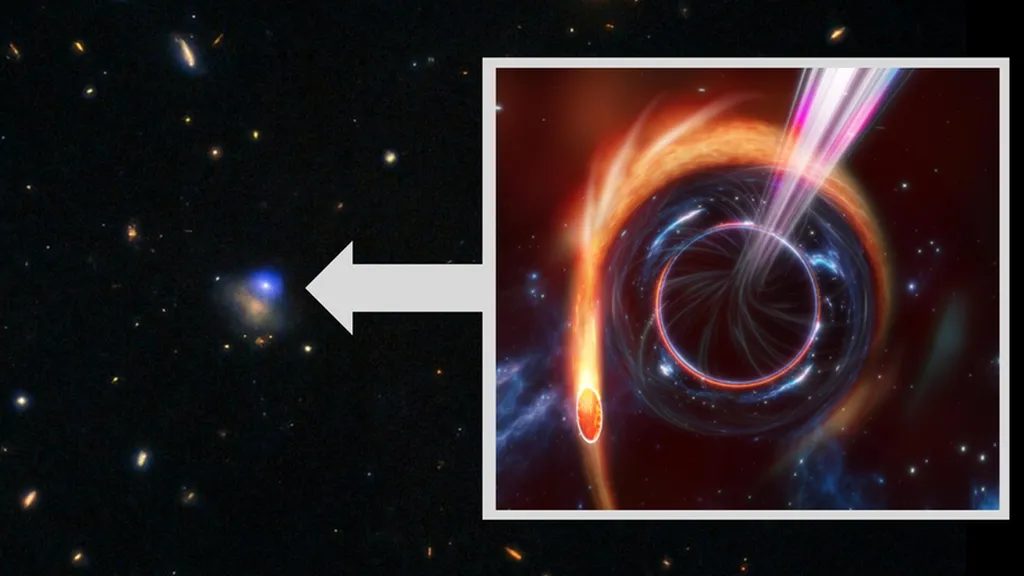
Researchers from the University of California, Irvine, and the Institute for Cosmic Ray Research at the University of Tokyo have delved into the potential of tidal disruption events (TDEs) as sources of high-energy neutrinos. Mainak Mukhopadhyay, Patrick Wusinich, and Kohta Murase have published their findings in a recent study, offering insights into the energy sector’s understanding of cosmic phenomena and their potential implications.
Tidal disruption events occur when a star passes too close to a supermassive black hole and is torn apart by the black hole’s tidal forces. These events have been theorized to produce high-energy neutrinos, which are subatomic particles that can provide valuable information about the most energetic processes in the universe. The researchers focused on the IceCube Neutrino Observatory’s high-energy starting events (HESE) dataset, which spans 12.5 years, to investigate the correlation between these neutrino events and a sample of 89 known TDEs.
Through a maximum likelihood analysis, the team found no significant spatial or temporal correlation between the HESE dataset and the TDE sample. This result suggests that the observed neutrino data are consistent with background noise, rather than originating from TDEs. Despite this, the researchers were able to place constraints on the fraction of TDEs that harbor intrinsic jets and the corresponding isotropic-equivalent cosmic ray energy. They found that for a fraction of TDEs with jets greater than 0.6, the cosmic ray energy must be less than approximately 3 x 10^53 erg at more than 90% confidence level.
The study also discusses the theoretical implications of these results and the limits on the all-sky diffuse neutrino flux from TDEs. As more observational data becomes available from electromagnetic and neutrino observations, the analysis presented in this work can be used to place stringent constraints on the physical parameters associated with TDEs. While this research does not directly impact the energy industry, it contributes to our broader understanding of high-energy astrophysical processes, which can have indirect implications for energy production and technology development.
The research was published in the journal Physical Review D, offering a valuable contribution to the field of astrophysics and neutrino research. As the energy sector continues to explore innovative solutions, understanding the fundamental processes governing our universe remains an essential pursuit.
This article is based on research available at arXiv.