
Researchers from the Institut de Mécanique des Fluides de Toulouse (IMFT) in France have conducted a study on the effect of wind turbulence on wave generation over viscous liquids. The team, led by Romain Mathis and including Sébastien Cazin, Jeanne Methel, François Charru, Jacques Magnaudet, Frédéric Moisy, and Marc Rabaud, aimed to understand how turbulence in the air influences the growth of waves on liquid surfaces and the transition between different wave regimes. Their findings were published in the Journal of Fluid Mechanics.
The researchers conducted experiments in a wind tunnel, where they blew air over a tank filled with silicone oil, which is fifty times more viscous than water. They enhanced the turbulence in the air flow using grids placed upstream and measured surface deformations with high precision using a technique called Free-Surface Synthetic Schlieren. They also measured velocities above the liquid’s surface using hot-wire anemometry and within the liquid using particle image velocimetry.
The study revealed two main effects of increased air turbulence: it amplified the amplitude of small, irregular wrinkles on the liquid’s surface and reduced the wind speed required for the transition to larger, regular waves. However, the transition between these two regimes still corresponded to a roughly constant friction velocity, which is a measure of the shear stress at the liquid’s surface. The researchers also found that, similar to a classical boundary layer over a flat plate, the friction velocity decreased with fetch, which is the distance over which the wind interacts with the liquid surface.
To explain their observations, the researchers developed a qualitative model based on a wave energy balance. They found that the decrease in friction velocity with fetch led to a non-monotonic variation of the wave amplitude with fetch, meaning that the wave amplitude initially increased with fetch, reached a maximum, and then decreased. This behavior is specific to highly viscous liquids like the silicone oil used in the study.
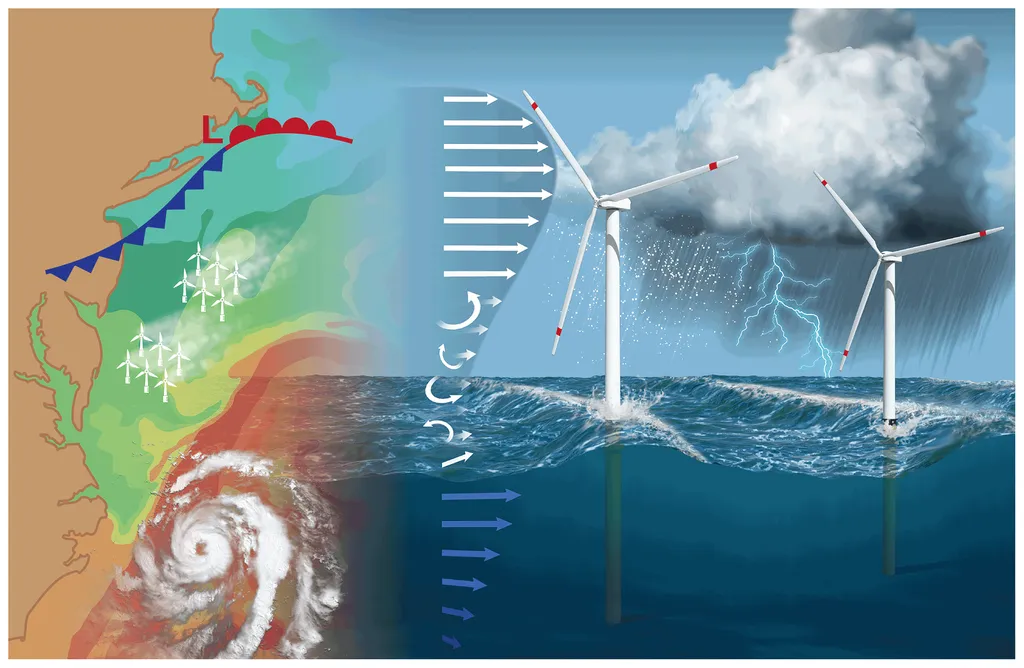
The findings of this research could have practical applications for the energy industry, particularly in offshore wind and wave energy sectors. Understanding how wind turbulence affects wave generation can help improve the design and efficiency of offshore wind turbines and wave energy converters. For instance, it could inform the placement of these devices in relation to the fetch and the expected wind conditions, optimizing their energy capture and reducing structural loads. Additionally, the insights gained from this study could contribute to better modeling and prediction of wave conditions in coastal and offshore environments, supporting the development of marine renewable energy projects.
This article is based on research available at arXiv.