
In the realm of energy research, a team of scientists from the University of North Carolina at Chapel Hill has made significant strides in understanding thermonuclear reaction rates, a critical aspect of astrophysics and nuclear energy applications. The researchers, led by Professor Christian Iliadis, include Richard Longland, Kiana Setoodehnia, Caleb Marshall, Peter Mohr, and Athanasios Pstaltis, who collectively have delved into the complexities of thermonuclear reactions to provide more accurate data for both scientific and industrial use.
The team’s work, titled “The 2025 Evaluation of Experimental Thermonuclear Reaction Rates (ETR25),” focuses on improving the estimation of thermonuclear reaction rates, which are essential for understanding nuclear processes in stars and have practical implications for nuclear energy technologies. The researchers employed modern statistical approaches, such as Monte-Carlo sampling and Bayesian models, to analyze and interpret experimental data. This methodology allows for a more nuanced understanding of the uncertainties involved in these reactions, providing a robust framework for future research and applications.
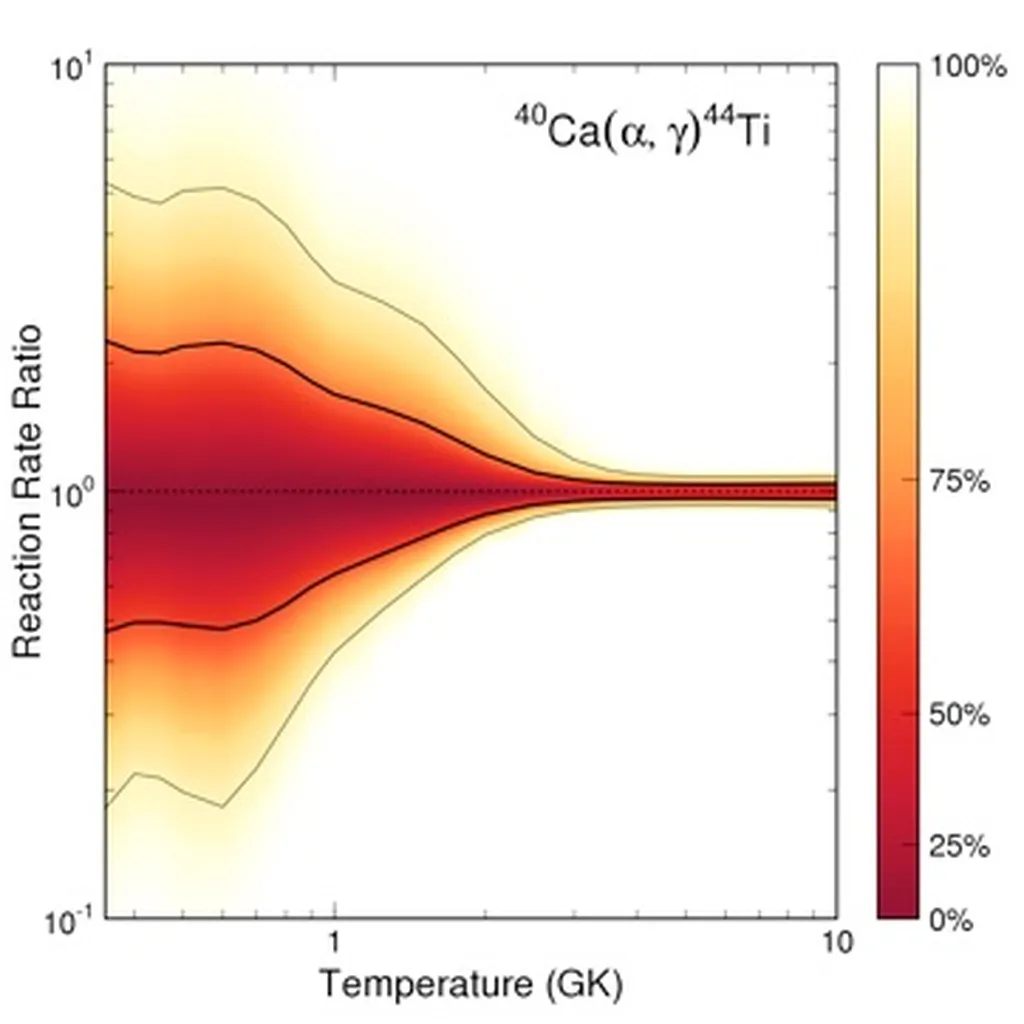
One of the key contributions of this study is the evaluation of 78 experimental charged-particle thermonuclear reaction rates for target nuclei in the A = 2 to 40 mass region. These evaluations cover a wide temperature range, from 1 million kelvin (MK) to 10 giga-kelvin (GK), which encompasses the conditions found in various astrophysical environments and nuclear reactors. For each reaction, the researchers provide three rate values: low, median, and high, corresponding to the 16th, 50th, and 84th percentiles of the cumulative reaction rate probability density distribution. This approach allows users to sample the reaction rate probability density in nucleosynthesis calculations, facilitating more accurate uncertainty estimates of nuclidic abundances.
The study also includes graphical representations that illustrate the fractional contributions to the overall reaction rate along with the associated uncertainties. These visuals are designed to assist both stellar modelers and nuclear experimentalists by identifying the primary sources of rate uncertainty at specific stellar temperatures. Additionally, the researchers provide a graphical comparison with earlier Monte-Carlo rates, highlighting the advancements and refinements made in this latest evaluation.
For the energy sector, these findings are particularly relevant for nuclear fusion research, where understanding and controlling thermonuclear reactions are paramount. The improved reaction rates and associated uncertainties can enhance the accuracy of models used in fusion energy research, potentially accelerating the development of sustainable and efficient fusion power plants. Furthermore, the methodologies and data provided by this study can be applied to other areas of nuclear energy, such as fission reactors and radioactive waste management, where a precise understanding of nuclear reactions is crucial.
The research was published in the esteemed journal “Nuclear Physics A,” a leading publication in the field of nuclear physics. This work not only advances our fundamental understanding of nuclear processes but also offers practical tools and data that can be immediately applied in the energy industry, paving the way for more efficient and sustainable energy solutions.
This article is based on research available at arXiv.