
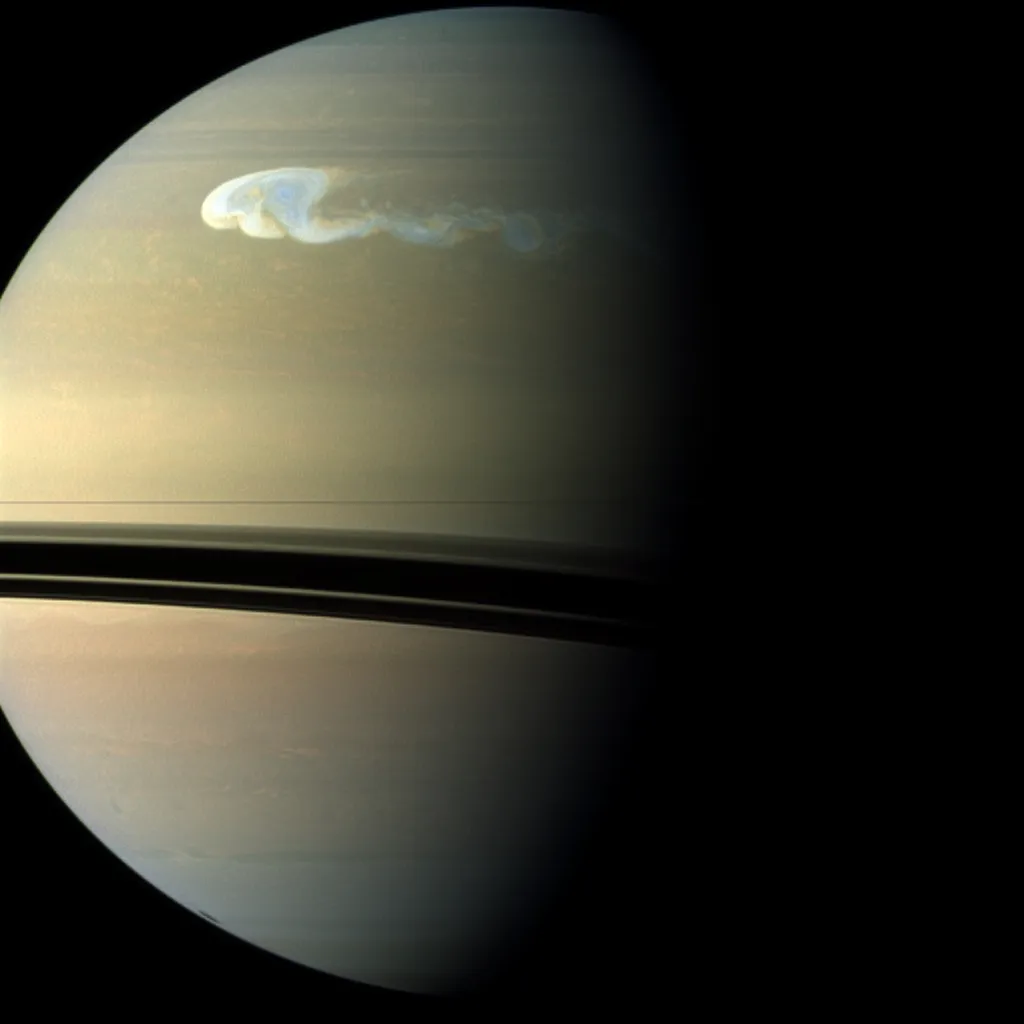
Researchers from France and the United States, including scientists from the Laboratoire d’Études Spatiales et d’Instrumentation en Astrophysique de l’Observatoire de Paris, the Institut de Planétologie et d’Astrophysique de Grenoble, and the Harvard-Smithsonian Center for Astrophysics, have conducted a study on the aftermath of Saturn’s Great Storm of 2010-2011. Their findings, published in the journal Astronomy & Astrophysics, provide insights into the storm’s impact on Saturn’s stratosphere and winds, with potential implications for understanding atmospheric dynamics on Earth and other planets.
The study focused on two main objectives: assessing whether the storm-induced stratospheric hot spot, known as the “beacon,” perturbed the distribution of carbon monoxide (CO) in Saturn’s stratosphere, and measuring how the vortex affected stratospheric winds. To achieve these goals, the researchers conducted interferometric observations of Saturn using the Submillimeter Array (SMA) and the Atacama Large Millimeter/submillimeter Array (ALMA) to spatially resolve CO emissions.
The researchers found that the meridional distribution of CO in Saturn’s stratosphere remained relatively constant despite the storm. The average CO mole fraction was determined to be around 1.7 x 10^-7 at a pressure level of 0.3 millibars, where the contribution functions peak. Importantly, the CO abundance did not show noticeable alterations in the beacon region, suggesting that the storm did not significantly impact CO distribution.
Regarding stratospheric winds, the study revealed striking differences between the wind patterns measured during the beacon’s active period and those observed in 2018, after the beacon had dissipated. The researchers identified the signature of the vortex as an anticyclonic feature. The equatorial prograde jet was found to be 100 to 200 meters per second slower and broader in latitude compared to quiescent conditions. Additionally, several prograde jets were detected in the southern hemisphere, and a retrograde jet was observed at 74 degrees north, which could be a polar jet caused by the interaction of Saturn’s magnetosphere with its atmosphere.
While this research focuses on Saturn, the findings contribute to a broader understanding of atmospheric dynamics and the impact of large-scale storms on planetary atmospheres. On Earth, understanding these processes can help improve weather forecasting and climate modeling. In the energy sector, better atmospheric models can enhance the accuracy of wind and solar energy predictions, leading to more efficient integration of renewable energy sources into the grid. Additionally, insights into atmospheric dynamics on other planets can inform the search for habitable exoplanets and the potential for energy generation in extraterrestrial environments.
Source: Astronomy & Astrophysics
This article is based on research available at arXiv.