
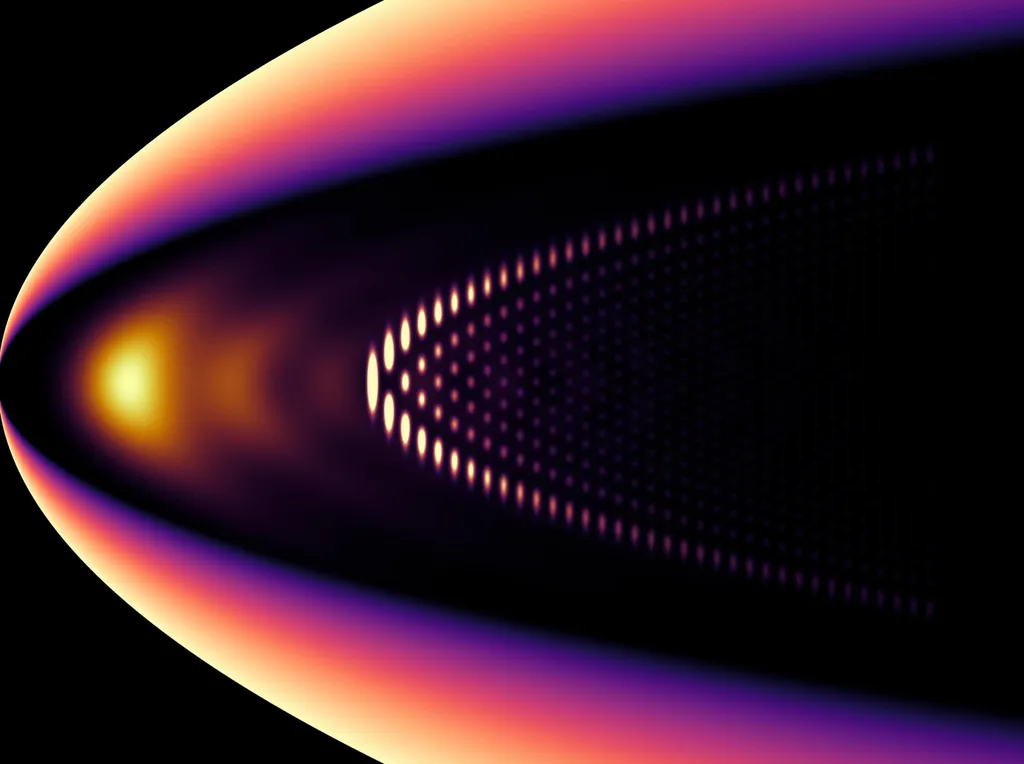
Researchers Guillermo Chacon-Acosta, H. Hernandez-Hernandez, and J. Ruvalcaba-Rascon from the Universidad Nacional Autonoma de Mexico have developed a new semiclassical framework to study quantum particles on curved surfaces, with potential applications in energy materials and technologies. Their work, published in the journal Physical Review E, extends classical phase-space to include quantum fluctuations, providing a more accurate description of quantum particles in curved geometries.
The researchers used the momentous quantum mechanics formalism to derive quantum-corrected Hamiltonians and trajectories for particles on a sphere. For a free particle, they found that quantum fluctuations induce measurable phase shifts in the particle’s precession, with uncertainty growth rates dependent on initial moment correlations. When a non-central Makarov potential was introduced, quantum corrections amplified the potential’s asymmetry, driving trajectories preferentially toward the southern hemisphere on timescales 40% shorter than classical predictions. This resulted in up to a three-fold enhancement in trajectory densities in the preferred region.
The researchers’ solutions rigorously satisfied Heisenberg uncertainty relations, validating their truncation scheme. Their results demonstrate that quantum effects fundamentally alter semiclassical dynamics in curved constrained systems. This has direct implications for several areas relevant to the energy sector, including charge transport in carbon nanostructures, exciton dynamics in curved quantum wells, and reaction pathways in cyclic molecules.
In practical terms, this research could help improve the design and performance of energy materials and technologies that rely on quantum effects, such as solar cells, light-emitting diodes, and catalysts. By providing a more accurate description of quantum particles in curved geometries, the researchers’ framework could enable the development of more efficient and effective energy materials and devices.
This article is based on research available at arXiv.