
In the realm of theoretical physics, a trio of researchers from the Indian Institute of Technology Madras—Dipayan Mukherjee, Harkirat Singh Sahota, and S. Shankaranarayanan—have made strides in understanding the universe’s behavior at its most fundamental level. Their work, published in the journal Physical Review D, draws an intriguing parallel between quantum cosmology and the hydrogen atom, offering insights that could potentially impact our understanding of the universe’s evolution and energy dynamics.
The researchers built upon their previous work that established a correspondence between quantum cosmology and the hydrogen atom. In their latest study, they focused on a specific scenario where the cosmological constant, a measure of the energy density of empty space, is negative. This is in contrast to our current understanding of the universe, which suggests a positive cosmological constant driving its accelerated expansion.
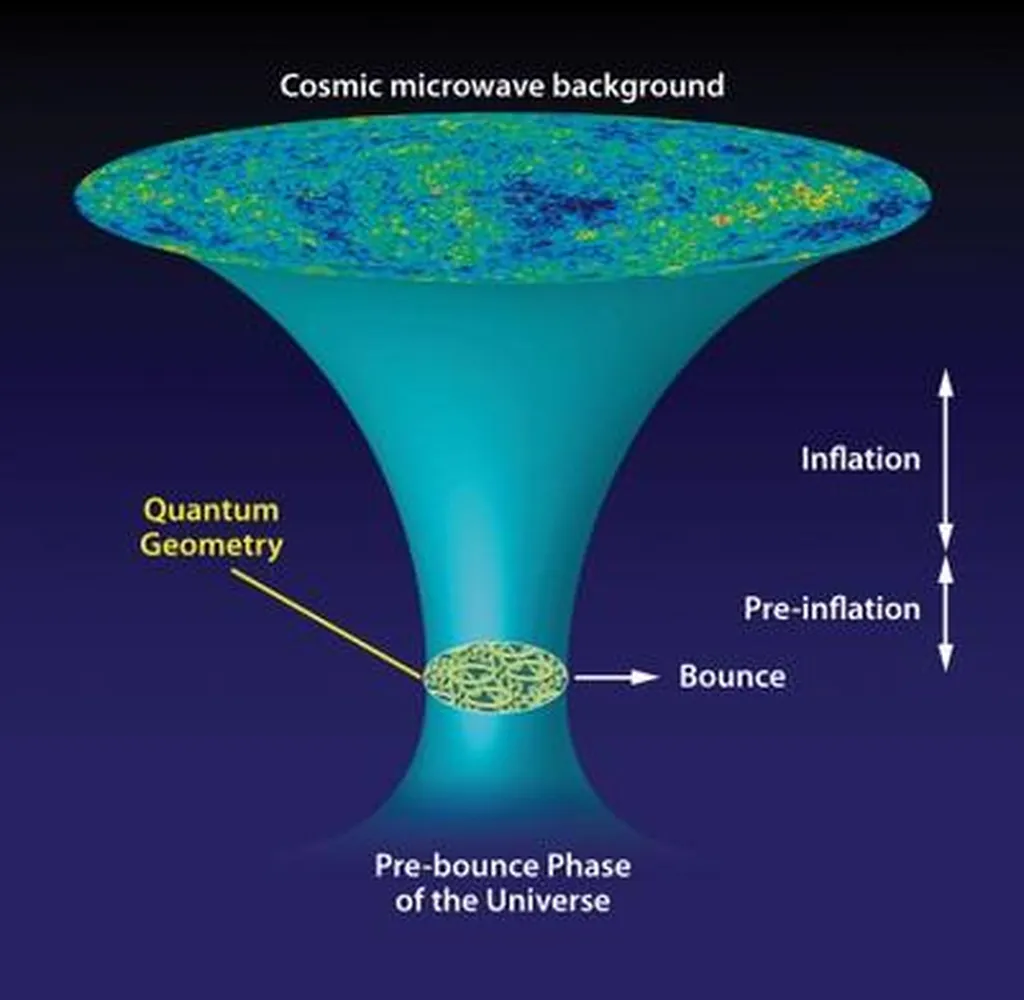
In a flat Friedmann-Lemaître-Robertson-Walker (FLRW) universe filled with dust, the researchers found that a negative cosmological constant leads to a discrete spectrum of energy eigenvalues. This quantization effectively means that the cosmological constant can only take on specific, discrete values, unlike the continuous spectrum observed in the positive cosmological constant scenario. This discrete nature gives rise to a cyclic universe, where the universe oscillates between periods of expansion and contraction, with quantum bounces replacing the classical Big Bang and Big Crunch singularities.
The researchers also demonstrated that the operator-ordering ambiguity parameter, a technical aspect of quantum mechanics, appears as the azimuthal quantum number of the hydrogen atom in this correspondence. This skewed Bohr correspondence matches classical evolution at large volumes but deviates near the bounce, offering a unique perspective on the universe’s behavior at its smallest scales.
The practical implications for the energy sector are not immediate, as this research is fundamentally theoretical. However, understanding the universe’s energy dynamics at a quantum level could potentially inform future energy technologies. For instance, a deeper comprehension of energy quantization and cyclic universes could inspire novel approaches to energy harvesting or storage. Moreover, the resolution of singularities in this model suggests a more nuanced understanding of energy densities and distributions in the universe.
In essence, this research offers a tractable setting to explore quantum gravitational effects in cosmology, providing a fresh lens through which to view the universe’s energy dynamics. The findings, while theoretical, could pave the way for innovative energy solutions in the future. The research was published in Physical Review D, a prestigious journal in the field of theoretical physics.
This article is based on research available at arXiv.